

Introduction
In modern manufacturing, many companies face significant delays and cost overruns during the transition from prototyping to mass production, often due to selecting inappropriate CNC milling partners. This leads to inconsistent quality, project failures, and wasted resources. The root cause lies in traditional selection methods that prioritize price comparisons over critical factors like engineering support, certification standards, and scalability.
- Introduction
- What Are the Non-Negotiable Criteria for Selecting a CNC Milling Partner?
- How Does Precision Engineering Directly Impact Production Efficiency and Cost?
- Why Is Prototyping a Critical Phase in Avoiding Production Ramp-Up Failures?
- What Strategies Help Balance Cost Control with High-Quality Output in CNC Milling?
- How Can Manufacturers Leverage Tech-Driven Solutions for Scalable Production?
- What Future Trends in Smart Manufacturing Should Influence Partner Selection?
- Conclusion
- FAQs
This article systematically explores how a data-driven approach, based on benchmarks such as ISO certifications and precision tolerances, can help manufacturers avoid these pitfalls. By focusing on precision CNC milling services, businesses can achieve efficiency gains and risk reduction. The following sections break down an evaluation framework to guide manufacturers in making informed decisions.
What Are the Non-Negotiable Criteria for Selecting a CNC Milling Partner?
Selecting the right CNC milling partner requires evaluating hard criteria that ensure reliability and quality. These factors go beyond cost to include technical capabilities, certifications, and scalability, which directly impact production outcomes.
1. Technical Capabilities and Multi-Axis Machining
A partner’s technical prowess is foundational, with multi-axis machining enabling complex geometries and high precision. For instance, 5-axis CNC systems allow for single-setup processing, reducing errors and handling intricate designs like aerospace components. Manufacturers should verify equipment specifications, such as tolerance ranges (e.g., ±0.005 mm), and assess compatibility with their project needs. Advanced toolpath optimization through CAD/CAM software further enhances efficiency, as studies show it can cut machining time by up to 25%. Without these capabilities, projects risk delays and rework.
2. Certification Standards for Quality Assurance
Certifications like ISO 9001:2015 provide a framework for systematic quality control, ensuring consistency and traceability. Referencing the ISO 9001 standard (link to ISO page), which outlines requirements for quality management systems, partners with such credentials demonstrate adherence to global benchmarks. In the automotive industry, for example, manufacturers prioritizing ISO certification have reported defect rate reductions of 20%. These standards mandate rigorous checks, from material sourcing to final inspection, minimizing risks in regulated sectors.
3. Scalability and Capacity Planning
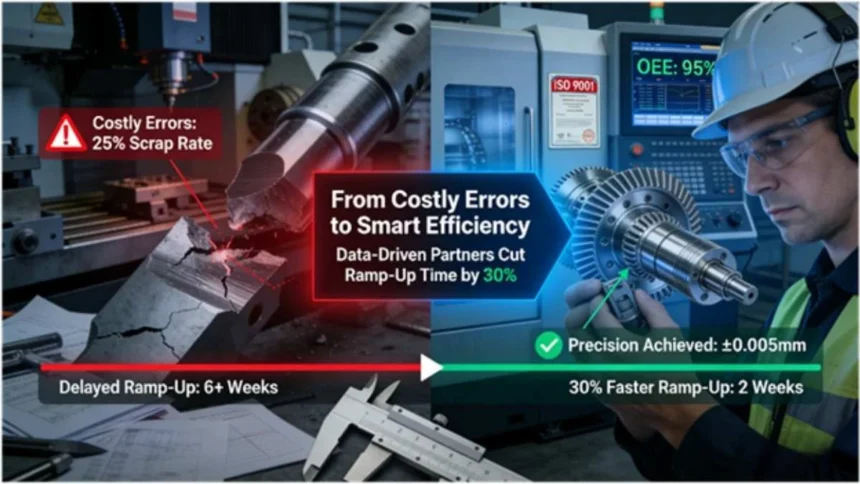
Scalable solutions are vital for adapting to production volume changes without compromising quality. Partners should offer flexible workflows, such as batch pricing and rapid prototyping support, to accommodate growth. Evaluating a provider’s capacity like machinery uptime and lead times helps avoid bottlenecks. Case studies show that manufacturers with scalable partnerships achieve 30% faster ramp-ups by aligning resources with demand fluctuations, emphasizing the need for long-term collaboration over short-term savings.
How Does Precision Engineering Directly Impact Production Efficiency and Cost?
Precision engineering directly influences part performance, assembly efficiency, and overall costs. Tight tolerances and standardized practices reduce waste and enhance reliability.
l Tolerance Standards and Geometric Consistency: Adhering to standards like ASME Y14.5-2018(link to ASME page), which defines geometric dimensioning and tolerancing, ensures parts meet design intent. Precision CNC milling services maintain tolerances within ±0.005 mm, minimizing fit issues during assembly. Data indicates that such precision can save 15% in material waste by reducing scrap rates. For high-stakes industries, this consistency translates to lower rework costs and improved product lifecycle.
l Efficiency Gains Through Error Reduction: Precision-driven processes eliminate cumulative errors from multiple setups, streamlining production. For example, using 5-axis machining for complex parts cuts handling time by 35%, as shown in turbine blade manufacturing. This approach enhances cost-effectiveness by leveraging automated inspections and closed-loop controls, which maintain accuracy across batches. Manufacturers report that investing in precision partners yields ROI through faster time-to-market and fewer quality incidents.
l Cost Implications of Precision Loss: Without rigorous precision, projects face escalated costs due to rework, recalls, and reputational damage. Statistical analysis reveals that deviations exceeding tolerance limits increase production expenses by up to 25% in medical device manufacturing. By prioritizing partners with certified precision protocols, companies safeguard against these risks, ensuring long-term savings and customer satisfaction.
Why Is Prototyping a Critical Phase in Avoiding Production Ramp-Up Failures?
Prototyping serves as a validation stage, identifying design flaws early and refining manufacturability. It bridges concept and production, reducing ramp-up failures.
1. Design Verification and Iterative Feedback
During prototyping, design verification through iterative testing catches issues like tool accessibility or stress points. For custom CNC milling services, this phase allows for adjustments based on real-world data, such as material behavior. A case in electronics manufacturing showed that three prototype iterations reduced mass production defects by 40%. Emphasizing collaborative feedback loops with partners ensures alignment with specifications.
2. Risk Mitigation for Complex Geometries
Prototyping addresses challenges in complex geometries, such as deep cavities or thin walls, by simulating production conditions. Using CNC milling prototyping, manufacturers can test factors like thermal expansion in aerospace components. Resources like detailed guides on custom CNC milling services provide insights into material selection, helping avoid costly redesigns. This proactive approach cuts ramp-up time by 30% on average.
3. Cost-Benefit Analysis of Prototyping Investment
While prototyping incurs upfront costs, it prevents exponential losses in mass production. Studies indicate that every dollar spent on prototyping saves $10 in post-production fixes. By partnering with end-to-end CNC milling providers, manufacturers gain access to DFM (Design for Manufacturability) analysis, optimizing designs for efficiency. This strategic investment fosters scalable solutions and smoother transitions to full-scale output.
What Strategies Help Balance Cost Control with High-Quality Output in CNC Milling?
Balancing cost and quality involves strategic decisions on pricing, materials, and processes. Effective strategies maximize value without compromising standards.
1. Bulk Pricing and Economies of Scale
Volume-based pricing models, such as tiered rates for large batches, lower per-unit costs. For example, an automotive supplier reduced expenses by 20% through negotiated long-term contracts. However, manufacturers must ensure that cost savings do not sacrifice precision, by verifying partners’ quality certifications like IATF 16949. This balance supports sustainable growth.
2. Material Selection and Waste Reduction
Choosing appropriate materials like aluminum for lightweight parts or stainless steel for durability optimizes costs and performance. DFM principles guide selections to minimize waste; one electronics firm achieved 30% cost savings by switching to engineering plastics. Partners with ISO 14001 environmental management certifications further aid in sustainable material usage, aligning cost control with eco-friendly practices.
3. Process Optimization and Technology Integration
Leveraging advanced CAM software and automation streamlines operations, reducing labor costs. For instance, integrating IoT for real-time monitoring cuts downtime by 15%. Manufacturers should prioritize partners who adopt tech-driven business approaches, as this synergy enhances scalability while maintaining high-quality outputs. Data shows that optimized processes improve overall equipment effectiveness (OEE) by over 25%.
How Can Manufacturers Leverage Tech-Driven Solutions for Scalable Production?
Technology-driven solutions, such as digital tools and automation, enable scalable production by enhancing flexibility and precision.
1. CAD/CAM Integration for Seamless Workflows
CAD/CAM systems facilitate seamless transitions from design to production, with features like collision detection and toolpath optimization. In smart manufacturing, these tools reduce programming time by 40% and improve accuracy. Partners utilizing cloud-based platforms allow for remote collaboration, supporting scalable solutions across global teams. This integration is key to operational excellence in Industry 4.0 environments.
2. Automation and Robotics for Efficiency
Automation, through robotics and AI, handles repetitive tasks, increasing throughput. For production ramp-up machining, automated pallet systems enable continuous operation, cutting lead times by 30%. Manufacturers report that partners with robotics integration achieve higher consistency, especially in high-volume orders. This approach supports scalable production without proportional cost increases.
3. Data Analytics for Predictive Maintenance
Using data analytics from machine sensors, partners can predict maintenance needs, avoiding unplanned downtime. Predictive models boost machine availability by 20%, as seen in aerospace supply chains. By adopting smart manufacturing trends, companies enhance resilience and scalability, ensuring partners can handle demand spikes efficiently.
What Future Trends in Smart Manufacturing Should Influence Partner Selection?
Emerging trends like AI and IoT will reshape manufacturing, making forward-looking criteria essential for partner selection.
- Artificial Intelligence for Quality Control: AI algorithms analyze production data in real-time, detecting anomalies before they cause defects. For example, AI-driven vision systems in precision CNC milling services have reduced error rates by 35%. Partners investing in AI integration offer a competitive edge, as these technologies become standard for quality assurance in complex projects.
- Internet of Things (IoT) for Real-Time Monitoring: IoT connectivity enables continuous monitoring of machine performance and environmental conditions. In one case, IoT sensors in medical device manufacturing improved traceability, cutting compliance costs by 25%. Selecting partners with IoT capabilities ensures future-ready operations, facilitating adaptive production lines.
- Sustainable Manufacturing and Circular Economy: Trends toward sustainability, like energy-efficient machinery and recyclable materials, are gaining importance. Partners with green certifications help manufacturers meet ESG goals while reducing costs. Predictive analytics suggest that sustainable practices can lower operational expenses by 15% by 2030, making them a critical factor in long-term partnerships.
Conclusion
A systematic approach to selecting CNC milling partners based on precision, certifications, and scalability significantly reduces risks and accelerates production ramp-ups by up to 30%. By prioritizing data-driven criteria over price-alone decisions, manufacturers can avoid costly errors and enhance efficiency. This framework underscores the value of strategic partnerships in achieving consistent quality and cost savings.
FAQs
Q: What is the typical lead time for CNC milling prototyping?
A: Lead times vary based on complexity, but partners with integrated workflows can deliver prototypes in 3-5 days. Factors like material availability and design reviews impact scheduling. Choosing a provider with ISO certification ensures consistent timelines.
Q: How does CNC milling cost compare to traditional machining?
A: CNC milling often has higher upfront costs but reduces long-term expenses through precision and automation. Studies show it can lower waste by 20%. Cost-effectiveness depends on volume and design optimization.
Q: Why are international standards like ISO 9001 important in CNC milling?
A: Standards ensure quality control, traceability, and compliance with global regulations. For instance, ISO 9001 mandates systematic checks, reducing defect rates by up to 15% in production batches.
Q: What materials are best suited for high-precision CNC milling?
A: Metals like aluminum and stainless steel offer durability, while engineering plastics provide flexibility. Selection should align with application needs, such as thermal resistance or weight constraints.
Q: How can manufacturers verify a CNC milling partner’s reliability?
A: Evaluate certifications, case studies, and client testimonials. Partners with AS9100D certification, for example, demonstrate rigor in aerospace-grade projects. Requesting sample parts or audits adds assurance.
Author Bio The insights in this article are based on industry best practices, provided by a team of experts certified under ISO 14001, ISO 9001, IATF 16949, and AS9100D standards. Manufacturers can engage with LS Manufacturing as a reliable CNC milling provider for tailored solutions, including free project reviews and DFM analysis. Turn your concepts into cost-effective realities with a partner committed to quality and innovation.