


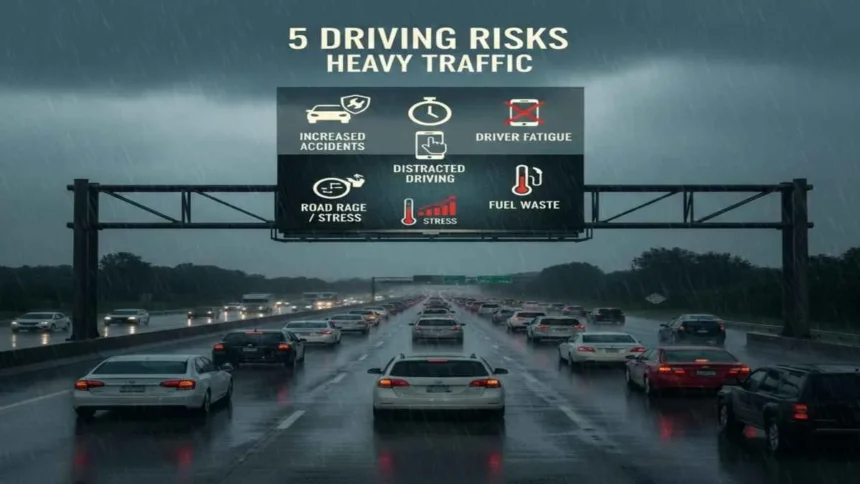
Have you ever found yourself inching forward on the freeway, bumper-to-bumper with hundreds of other cars, feeling your stress levels rise with every minute that ticks by? We’ve all been there. Heavy traffic is more than just a nuisance that makes you late for work; it’s a complex driving environment that significantly alters the safety dynamics of the road. When congestion hits, the rules of the road seem to shift, and the likelihood of certain types of accidents skyrockets.
Navigating gridlock requires a different mindset and a heightened sense of awareness compared to open-road driving. The proximity of other vehicles, the constant stop-and-go motion, and the collective frustration of drivers create a perfect storm for mishaps. Understanding these specific dangers is the first step toward protecting yourself and your passengers. In this article, we’ll explore five critical driving risks that escalate when the roads get crowded, helping you stay safe even when the traffic flow grinds to a halt.
1. The Domino Effect of Rear-End Collisions
One of the most common consequences of heavy traffic is the dreaded rear-end collision. In free-flowing traffic, you generally have ample space to brake gradually. However, in dense congestion, that buffer zone disappears. The constant cycle of accelerating and braking creates a rhythmic but dangerous pattern known as the “accordion effect.” When one driver slams on their brakes unexpectedly, the driver behind them has mere milliseconds to react.
This risk is compounded by distraction. A momentary glance at a phone or a GPS can be the difference between a safe stop and a fender bender. To mitigate this, seasoned drivers increase their following distance as much as possible, even in slow traffic. It acts as a safety cushion, absorbing sudden stops. Furthermore, keeping your vehicle in top condition is vital. If your brakes are worn or your tires lack grip, your stopping distance increases, turning a close call into a collision. Regular maintenance, such as getting a timely oil change in Provo, Utah, often includes a multi-point inspection where mechanics can spot these wear-and-tear issues before they become dangerous liabilities on a crowded highway.
2. Increased Aggression and Road Rage
There is something about being stuck in a jam that brings out the worst in people. Psychological studies have shown that traffic congestion is a significant stressor that can trigger aggressive behavior in otherwise calm individuals. When drivers feel trapped or delayed, patience wears thin, leading to risky maneuvers like cutting others off, tailgating, or blocking intersections.
Road rage isn’t just about yelling or honking; it translates into physical actions that endanger everyone nearby. An aggressive driver might weave through lanes without signaling, attempting to gain a few car lengths, only to cause a side-swipe accident. The best defense against this is emotional regulation and defensive driving. If you spot an aggressive driver, the safest move is to let them pass and distance yourself from them. Engaging or competing with them only escalates the danger. Remember, arriving five minutes late is always better than not arriving at all due to an avoidable confrontation.
3. The Blind Spot Danger Zone
In heavy traffic, cars are often packed tightly together, frequently lingering in each other’s blind spots for extended periods. On an open highway, a car might pass you quickly, staying in your blind spot for only a second or two. In gridlock, a vehicle might ride alongside your rear quarter panel for miles.
This proximity makes lane changes incredibly risky. A driver might check their mirror, see a space, and begin to merge, not realizing a motorcycle or small car is hovering just out of sight. This risk is particularly high for larger vehicles like trucks and SUVs, which have larger blind spots. To navigate this safely, drivers must physically turn their heads to check blind spots before every move—relying solely on mirrors is a recipe for disaster in heavy traffic. Additionally, try to avoid driving in others’ blind spots; if you can’t see the other driver’s face in their side mirror, they likely can’t see you.
4. Unpredictable Merging and Lane Changes
Desperation often drives decision-making in traffic jams. Drivers who realize they are in the wrong lane for an upcoming exit may make sudden, erratic moves to cross multiple lanes of traffic. This unpredictability is a major hazard. When cars are moving slowly, drivers often feel a false sense of security, believing they can squeeze into small gaps that wouldn’t exist at high speeds.
This “forcing the merge” behavior disrupts the flow and forces other drivers to brake hard, which ripples back through the line of traffic (referencing the rear-end collision risk mentioned earlier). Furthermore, motorcyclists often engage in lane splitting—riding between lanes of slow-moving or stopped traffic. While legal in some places, it catches many drivers off guard. Staying in your lane unless necessary and signaling early are courteous habits that significantly reduce confusion and collision risk during peak hours.
5. Driver Fatigue and Highway Hypnosis
Paradoxically, moving slowly can be just as tiring as driving fast. The monotony of stop-and-go traffic can lead to a state of mental fatigue or “highway hypnosis,” where a driver operates the vehicle on autopilot without conscious awareness. The mental load of constantly processing the brake lights ahead, monitoring mirrors, and managing frustration drains cognitive energy rapidly.
Fatigued drivers have slower reaction times and impaired judgment. In a high-stakes environment where cars are inches apart, a split-second delay in reaction can result in an accident. To combat this, staying engaged helps. Keep the cabin cool, listen to engaging (but not distracting) audio content, and maintain good posture. If you feel your eyelids getting heavy or your attention drifting, it’s safer to pull over and take a short break than to risk drifting into the car ahead of you.
Heavy traffic is an unavoidable reality of modern driving, but it doesn’t have to be a guarantee of an accident. By recognizing the heightened risks of rear-end collisions, aggressive behavior, blind spot loitering, erratic merging, and driver fatigue, you can adjust your driving style to compensate. Stay alert, leave space, and keep your cool. Your safety is worth far more than the few minutes you might save by rushing.