


Glossophobia, or the fear of public speaking, affects roughly 75% of the population. When we step onto a stage or in front of a camera, our first instinct is often to focus entirely on our script. We obsess over the words, memorizing lines and fact-checking data until we are blue in the face. While content is obviously critical, it isn’t the only factor that determines your success.
Visual confidence, how you carry yourself, how you move, and how you interact with your environment—speaks volumes before you even utter a single syllable. Research suggests that a significant portion of human communication is non-verbal. If your body language screams “I’m terrified,” your audience will feel that anxiety, regardless of how brilliant your ideas are.
Whether you are a tech CEO launching a new product, a student defending a thesis, or one of many Anchorage dentists presenting at a local medical seminar, the way you visually present yourself dictates how your message is received. Mastering your visual presence transforms you from a nervous presenter into a commanding authority.
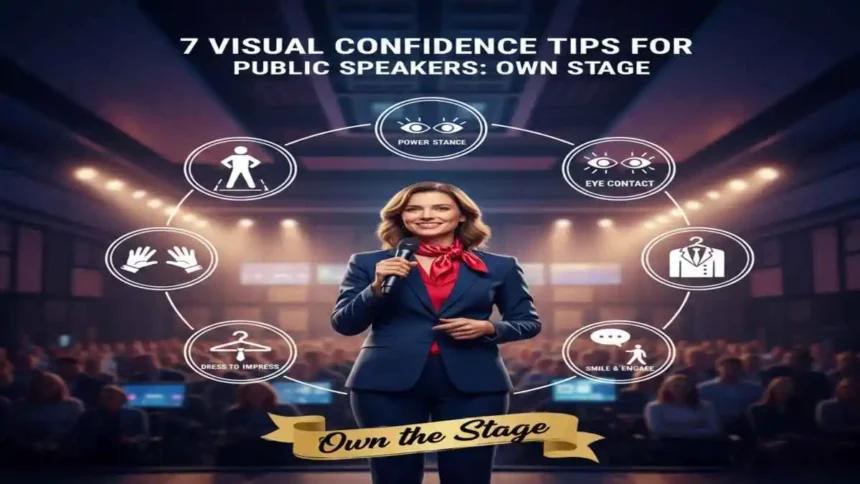
Here are seven practical tips to boost your visual confidence and keep your audience engaged.
1. Master the Art of Eye Contact
The old advice of “scanning the room” often leads to a ping-pong effect where you never actually connect with anyone. This makes you look shifty and nervous. True visual confidence comes from direct connection.
Instead of scanning, try the “one thought, one person” technique. Lock eyes with a single member of the audience and deliver one full sentence or thought directly to them. When you reach a punctuation point, move to another person. This creates a series of mini-conversations rather than a broadcast. It makes you appear more sincere and helps you gauge real-time feedback from the room. If the crowd is too large or the lights are too bright, look at specific zones in the audience rather than individual faces, but hold your gaze there long enough to establish a presence.
2. Occupy Space with Your Posture
When we feel threatened or nervous, our evolutionary instinct is to make ourselves smaller. We hunch our shoulders, cross our arms, and keep our elbows tucked tight to our ribs. This “closed” body language signals defensiveness and insecurity.
To project confidence, you must do the opposite: open up. Stand with your feet shoulder-width apart. This provides a solid physical base that stops you from swaying. Roll your shoulders back and keep your chest open. This isn’t just about looking good; it actually helps you breathe better, which in turn calms your nervous system. By physically occupying more space, you signal to the audience—and to your own brain—that you belong there.
3. Use Purposeful Hand Gestures
What do I do with my hands? It is the most common question aspiring speakers ask. Hiding them in your pockets, clasping them behind your back, or gripping the podium until your knuckles turn white are all visual cues of anxiety.
Your hands are tools for emphasis. Use them to illustrate your points. If you are talking about a big problem, widen your arms. If you are detailing a small nuance, bring your fingers closer together. Keep your gestures generally within the “strike zone”—the area between your shoulders and your belt. Gestures outside this box can seem erratic, while gestures too low can go unnoticed. When you aren’t gesturing, let your hands rest naturally at your sides. It feels awkward at first, but it looks incredibly relaxed to the audience.
4. Eliminate Distracting Fidgets
Nervous energy has to go somewhere. For many, it manifests as fidgeting. This might look like playing with a ring, clicking a pen, fixing hair, or shifting weight from foot to foot. These “tells” distract the audience from your message.
The first step to fixing this is awareness. Record yourself practicing. Watch the playback specifically to hunt for repetitive, unintentional movements. Once you identify your specific fidget, you can work to replace it with stillness. If you tend to sway, plant your feet. If you play with your hair, tie it back. Visual confidence is often defined by the absence of unnecessary movement.
5. Dress for the Role (and Comfort)
Your attire is the very first piece of visual information the audience receives. It sets the tone for your credibility. However, there is a delicate balance between looking professional and feeling comfortable.
If you are wearing a suit that is too tight or heels that hurt your feet, that physical discomfort will bleed into your facial expressions and body language. You will look stiff and distracted. Choose an outfit that makes you feel powerful but allows you to move freely. You want to be able to raise your arms, walk across the stage, and breathe deeply without wardrobe malfunctions. When you feel good in what you’re wearing, you naturally stand taller.
6. Mirror Your Content with Facial Expressions
Your face should match your message. It sounds simple, yet many speakers suffer from “resting nervous face”—a blank, stoic expression caused by intense concentration. If you are sharing exciting news but your face looks bored or terrified, the audience will be confused by the disconnect.
Smile when you are introduced; it triggers mirror neurons in the audience, making them smile back and helping them like you instantly. When discussing something serious, let your brow furrow slightly. Your facial expressions act as emotional guideposts for the audience, showing them how they should feel about the information you are sharing.
7. Move with Intent
The podium can be a shield, but it can also be a barrier. If you have the option, stepping away from the podium removes that physical wall between you and the audience, instantly building trust.
However, moving around the stage requires purpose. Avoid aimless pacing, which resembles a caged tiger. Instead, use movement to mark transitions in your speech. If you are moving from Point A to Point B in your argument, physically walk to a new spot on the stage. Stop, plant your feet, and deliver the next section. This physical movement helps the audience visually track the progression of your talk.
Making Visual Confidence Your Superpower
Public speaking is a performance, and like any performance, the visual component is critical. You don’t need to be a Hollywood actor to command a room. You simply need to be intentional with your body.
By mastering your eye contact, posture, gestures, and movement, you ensure that your body is reinforcing your message rather than detracting from it. Practice these visual cues just as much as you practice your script. With time, these physical adjustments will stop feeling like a performance and start feeling like second nature, allowing your true confidence to shine through.