


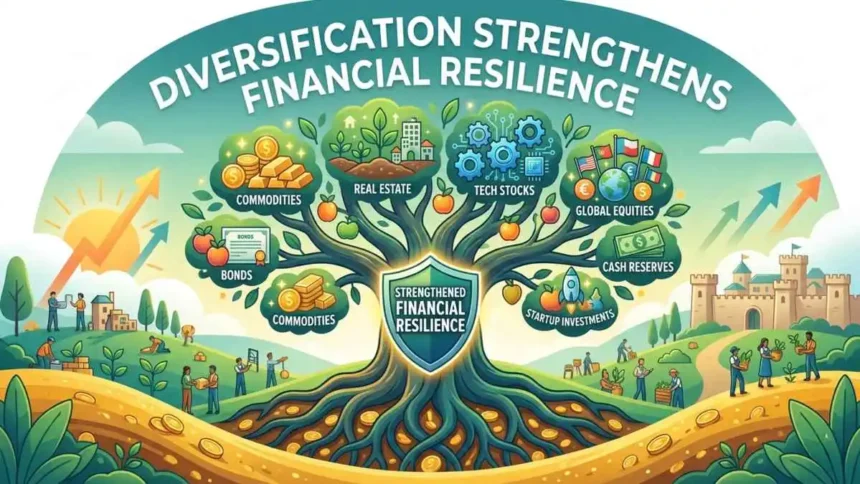
Do Not Let One Thing Carry Everything
Financial resilience is not just about having more money. It is about building a life where one problem does not knock everything over. A job loss, market drop, medical bill, rent increase, business slowdown, or unexpected repair can create stress, but it does not have to destroy the whole structure if your money is spread across more than one support.
- Do Not Let One Thing Carry Everything
- Diversification Is a Shock Absorber
- Spreading Risk Does Not Mean Avoiding Risk
- Asset Allocation Is the Foundation
- Income Diversification Creates Breathing Room
- Emergency Savings Is Diversification Against Surprise
- Avoid Concentration in Your Financial Life
- Diversification Can Reduce Emotional Decision Making
- Do Not Confuse Diversification with Clutter
- Rebalance As Life Changes
- Strength Comes from Many Supports
That is the real power of diversification. It keeps your financial life from depending on a single outcome. Instead of placing all your hope in one stock, one income source, one industry, one client, one account, or one strategy, you create layers. If one area struggles, another may help absorb the impact.
This idea matters whether someone is investing, running a small business, building savings, or trying to recover from debt. A person exploring debt solutions may be focused on immediate relief, but long-term resilience also requires thinking about future risks. Once the urgent pressure is addressed, the next question becomes: how can I build a financial life that is less vulnerable next time?
Diversification Is a Shock Absorber
Think of diversification like a shock absorber. It does not prevent bumps in the road. It helps keep the whole vehicle from shaking apart when those bumps happen.
In investing, diversification means holding a mix of assets instead of relying on one company or one sector. Some investments may rise while others fall. Some may grow slowly but provide stability. Others may be more volatile but offer growth potential. The goal is not to make every investment win at the same time. The goal is to reduce the damage if one part performs poorly.
The U.S. Securities and Exchange Commission’s Investor.gov defines diversification as a strategy that spreads investments among different assets to reduce risk. That sounds simple, but the mindset is powerful beyond the stock market too. Resilience grows when no single piece of your financial life has the power to ruin everything.
A diversified life has backups. A diversified portfolio has balance. A diversified income plan has more than one path.
Spreading Risk Does Not Mean Avoiding Risk
Diversification is not the same as hiding from risk. Every financial choice carries some risk. Cash can lose purchasing power to inflation. Stocks can drop. Bonds can fluctuate. Real estate can require repairs or lose value. Businesses can slow down. Jobs can change. Even doing nothing has consequences.
The point is not to remove risk completely. That is impossible. The point is to choose risks carefully and avoid concentrating too much exposure in one place.
For example, owning stock in one company can be exciting if that company performs well. But if too much of your money is tied to that one company, your financial future becomes dependent on its success. If the company struggles, your savings may suffer heavily. Holding a broader mix of investments can reduce that danger.
The same logic applies to income. A freelancer who depends on one client may feel stable until that client leaves. A household that depends on one income may be fine until a layoff happens. A business that sells one product to one customer group may grow quickly, then struggle when demand shifts.
Diversification says, “Let us not make one thing responsible for everything.”
Asset Allocation Is the Foundation
Diversification often starts with asset allocation, which means deciding how your money is divided among different categories such as stocks, bonds, cash, real estate, or other assets. The right mix depends on your age, goals, timeline, income, risk tolerance, and current financial needs.
Someone saving for a house in two years may need a very different mix than someone investing for retirement in thirty years. Money needed soon usually should not be exposed to major market swings. Money meant for long term growth may need more investment risk to keep up with inflation and build wealth over time.
FINRA’s guide to asset allocation and diversification explains how spreading investments across different asset categories can help manage risk. The important lesson is that diversification is not random. It should match the job each dollar has.
Some dollars need safety. Some need growth. Some need liquidity. A resilient structure gives each category a role.
Income Diversification Creates Breathing Room
Investments are not the only place diversification matters. Income diversification can also strengthen resilience.
For some people, this may mean building a side business, freelancing, renting out a room, earning certifications, creating digital products, consulting, or developing skills that make them employable in more than one field. For others, it may simply mean not letting one employer, one client, or one type of work define every future option.
Income diversification does not mean everyone needs to hustle nonstop. That can lead to burnout. It means building optionality. If one income stream weakens, another may help. If one industry changes, your skills can transfer. If one job ends, you are not starting from zero.
Even skill diversification matters. Learning budgeting, communication, technology, leadership, writing, sales, repair, caregiving, or project management can make you more adaptable. Skills are financial assets too because they improve your ability to earn, adjust, and recover.
Emergency Savings Is Diversification Against Surprise
An emergency fund is one of the most basic forms of diversification. It separates your short-term safety from credit cards, loans, or selling investments at the wrong time.
Without emergency savings, every surprise can become debt. A car repair becomes a balance. A medical bill becomes a payment plan. A job gap becomes a crisis. With even a small emergency fund, you create space between the event and the consequence.
This does not mean you need a perfect savings account before you start making progress elsewhere. Even a few hundred dollars can reduce stress. Over time, building toward several months of essential expenses can make your financial life much more resilient.
Emergency savings is not glamorous. It will not impress anyone online. But it gives you options, and options are the heart of resilience.
Avoid Concentration in Your Financial Life
Concentration risk happens when too much depends on one thing. It can show up quietly.
You may work for a company and also hold most of your retirement in that company’s stock. You may own a business and keep all your personal savings tied up in it. You may rely on one tenant, one customer, one industry, or one family member for financial stability. You may keep all your money in one type of account without thinking about liquidity, taxes, or risk.
Sometimes concentration happens because one area has performed well. A stock rises, a business grows, or a property gains value. That can feel like success, and it may be. But as one piece grows, it can become too large a share of the total picture.
Resilience requires periodic review. Ask yourself: if this one thing dropped in value, disappeared, or stopped producing income, what would happen? If the answer is “everything would fall apart,” that is a signal to diversify.
Diversification Can Reduce Emotional Decision Making
Financial stress often leads to reactive choices. When your money is too concentrated, every market dip, client issue, or job concern can feel personal and urgent. You may panic sell, overcorrect, borrow too quickly, or make decisions based on fear.
Diversification can reduce emotional intensity. If you know your entire future is not tied to one investment, you may be less likely to react to short term movement. If you have savings, a job skill, and another source of income, a setback may still hurt, but it may not feel like total collapse.
This emotional benefit is easy to overlook. A diversified structure can help you think more clearly because it gives your nervous system fewer reasons to panic. You are not depending on one narrow bridge. You have more than one way across.
Do Not Confuse Diversification with Clutter
Diversification should create strength, not confusion. Owning many random investments is not automatically better. Having too many accounts, side projects, or financial products can become messy if there is no clear purpose.
Good diversification is intentional. Each part has a role. A retirement account may focus on long term growth. A savings account may protect short term needs. A checking account may handle monthly bills. A brokerage account may support medium- or long-term goals. A side income stream may provide flexibility. Insurance may protect against risks that savings alone cannot cover.
Clutter makes money harder to manage. Structure makes diversification useful.
A good question is, “What purpose does this serve?” If you cannot answer, it may be complexity rather than resilience.
Rebalance As Life Changes
Diversification is not a one-time decision. Your life changes, and your financial structure should change with it.
A young investor may focus more on growth. A person nearing retirement may want more stability. A new parent may need more emergency savings and insurance. A business owner may need to separate personal and business risk. Someone who receives a raise may need to increase savings before lifestyle costs rise.
Investment portfolios can also drift overtime. If one asset class grows faster than others, your mix may become riskier than intended. Rebalancing helps bring the portfolio back in line with your goals.
The same is true outside investing. If your side income becomes your main income, your risk profile changes. If housing costs rise, your cash cushion may need to grow. If debt is paid down, you may have more room to invest.
Resilience is maintained through review, not neglect.
Strength Comes from Many Supports
Diversification strengthens financial resilience because it accepts a simple truth: no one can predict everything. Markets change. Jobs change. Health changes. Families change. Costs change. Goals change.
Instead of trying to guess the future perfectly, diversification prepares you for a range of futures. It spreads risk, balances growth with stability, protects against surprises, and gives you more than one way to recover from setbacks.
A resilient financial life is not built on one lucky bet. It is built on many supports working together. Savings, income, skills, investments, insurance, debt management, and thoughtful planning all play a role.
You do not need to diversify everything overnight. Start where the risk is most concentrated. Build a small emergency fund. Review your investments. Strengthen your skills. Reduce dependence on one source of income if possible. Pay attention to where one failure would create the most damage. The goal is not to make life risk free. The goal is to make it sturdier. When your money has more than one support beam, the whole structure has a better chance of standing through change.