


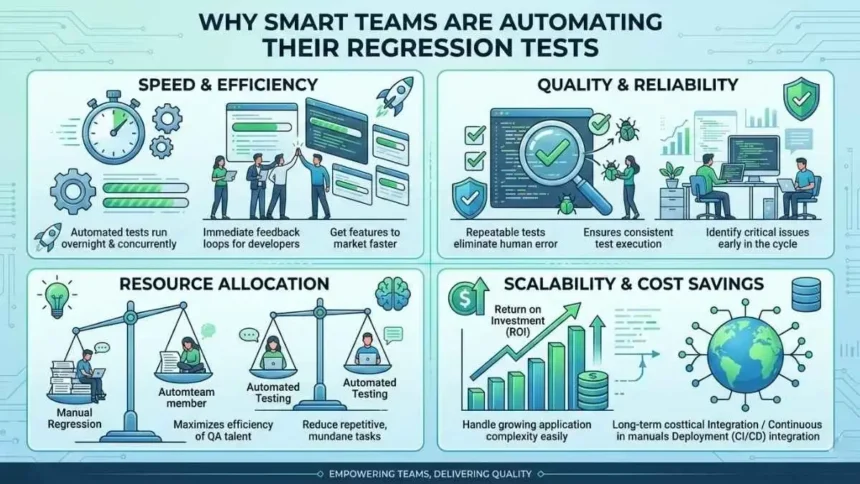
The rapid changes in software development may not be easy to follow besides keeping quality. Whenever developers are adding new features or trying to eliminate bugs, they should ensure that the existing functionality remains rock solid. This is where teams automate regression testing, making a game-changer for development companies everywhere in the world and transforming the way they offer their users reliable software.
1. Faster Feedback Loops Mean Quicker Releases
Your entire release cycle is slowed down by bottlenecks caused by manual testing, which might take days or even weeks to finish. Regression tests that are automated execute in a matter of minutes or hours as well as give prompt feedback when something goes wrong. Your engineers are able to detect bugs in their code modifications immediately instead of struggling with them several weeks on. Due to this acceleration, your team will be in a position to provide updates on a shorter basis and respond fast to the needs of the market and outperform competitors who are still languishing in their tedious manual testing processes.
2. Significant Cost Savings Over Time
Automation setup costs money up front, but there are significant long-term financial rewards. After each upgrade, manual testers spend endless hours redoing the same test cases, which results in enormous labor expenses every year. Your quality assurance team may concentrate on exploratory testing along with complicated scenarios that require human intelligence by having automated tests run repeatedly at no extra cost. Businesses usually recoup their automation investment in a matter of months, after which they continue to save money and greatly increase their testing coverage over the course of the software lifecycle.
3. Improved Test Coverage Across Your Application
Human testers simply cannot always run thousands of test cases with multitude of operating systems, and devices, as well as browsers in a decent amount of time. Automation makes comprehensive testing examine every feature, pathway and edge case possible. Your regression suite may expand with your application, guaranteeing comprehensive validation for both new features as well as legacy functionality. This thorough coverage prevents costly production mishaps that harm your reputation and shields your users from unpleasant experiences by identifying minor defects that manual testing would overlook.
4. Consistent and Reliable Test Execution
Errors are caused by human weariness, particularly when testers do repetitive activities daily. During tiresome testing sessions, someone may skip stages, misinterpret results, or just lose focus. Automated tests follow exact scripts without modification or interruption and run the same way each time. By removing human error from your regression testing procedure, this consistency guarantees that your quality standards will always be high. Your stakeholders may make confident decisions about release preparedness based on objective facts since they can fully trust the outcomes.
5. Better Resource Allocation for Your Team
Skilled professionals can offer their knowledge where it matters most when they are freed from tedious regression testing. Your quality assurance experts can concentrate on creating more effective test plans, studying intricate integration scenarios that are difficult for automation to handle, and creatively probing user processes. Instead of only identifying flaws, developers and testers can work together more closely to prevent them. By using strategic thinking instead of robotic checkbox exercises, this change in resource allocation boosts team morale, lowers burnout, and eventually results in higher-quality software.
Conclusion
Successful companies’ approaches to software quality have fundamentally changed as a result of automated regression testing. It is now a competitive requirement rather than a nice-to-have. Opkey stands apart in this evolution. Its AI-powered, agentic platform, specifically designed for regression testing, significantly lowers testing time, effort, and risk while increasing coverage and dependability.
Regression cycles have been reduced by 68% by companies like Just Group, demonstrating how Opkey transforms complexity into clarity. Opkey guarantees that technology investments yield quantifiable return on investment by resolving legacy issues and coordinating testing with actual business procedures. Opkey enables teams to modernize enterprise systems without sacrificing quality thanks to quicker releases, reduced maintenance expenses, and little human labor.