


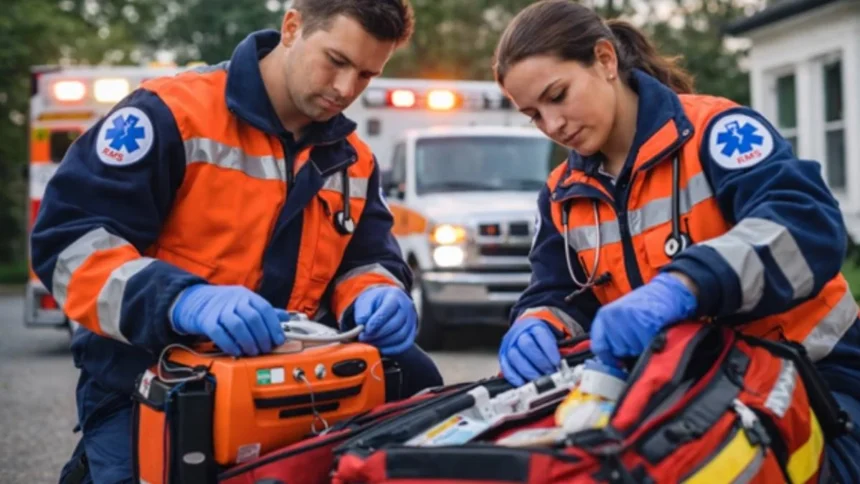
Emergency medical responder roles are in higher demand than ever. Here’s what’s driving the push—and the practical step most candidates skip before exam day.
Something quiet has been happening across firehouses, police precincts, factory floors, and rural volunteer squads over the past couple of years. More and more people are sitting down to earn their Emergency Medical Responder credential. The numbers from the National Registry back this up: EMR applications have climbed steadily since 2023, and the pace has not slowed heading into 2026.
The reasons are not hard to find. Rural hospitals keep closing. Staffing shortages in EMS have stretched response times in dozens of states. And employers, from construction companies to school districts, have started requiring, at a minimum, an EMR card for anyone in a safety-sensitive role. What used to feel like an optional box to check has quietly become a baseline expectation in a lot of industries.
What the EMR Certification Actually Covers
There is still plenty of confusion about what the EMR credential is and is not. It is not a paramedic license, and it is not the same as a basic first-aid course. The Emergency Medical Responder sits at the entry level of the official EMS licensure ladder above layperson CPR, below EMT. The scope of practice is real. Certified EMRs are trained to manage airways, control hemorrhage, assist with childbirth, and recognize the early signs of stroke and cardiac arrest.
The National Registry of Emergency Medical Technicians (NREMT) administers the cognitive exam through Pearson VUE testing centers. The test runs between 90 and 110 questions and uses computerized adaptive testing, meaning the exam adjusts in difficulty based on how you are performing. Most candidates find the format more demanding than a straightforward multiple-choice test because there is no gaming the pattern. You either know the material, or you do not.
“The EMR exam doesn’t reward memorization nearly as much as people expect. It rewards understanding why a specific intervention is appropriate in a specific situation.”
Content is weighted across five main domains: airway and respiration, cardiology and resuscitation, trauma, medical and obstetrics, and EMS operations. The medical and OB/GYN section carries the heaviest load, roughly 27 to 31 percent of the exam, which surprises a lot of first-time candidates who assume trauma questions will dominate.
The One Step Most Candidates Skip
Here is where things get interesting. A significant portion of people who fail the EMR cognitive exam on the first attempt do not fail because they skipped the coursework. They fail because they underestimated how differently the NREMT phrases its questions compared to how information is presented in textbooks and classroom instruction.
NREMT questions are scenario-based. They describe a patient, a setting, and a situation, then ask what the most appropriate next action is. The word “most” does a lot of heavy lifting. Two answer choices may both be medically defensible, but only one reflects proper EMR scope of practice and prioritization. That distinction is something you have to practice, not just read about.
Candidates who perform well consistently report one thing: they spent meaningful time working through a quality EMR practice test before ever walking into the testing center. Not skimming a few sample questions, actually sitting through full-time sessions, reviewing every wrong answer, and understanding the reasoning behind each correct choice.
Read Also: How US Students Can Balance Academics & Mental Well-Being
What Good Practice Looks Like in 2026
The options for test prep have expanded considerably. There are still the old-school flashcard decks and the textbook end-of-chapter quizzes, and those have their place. But the candidates who tend to pass on the first attempt are the ones who simulate the actual exam format, timed, scenario-driven, adaptive, rather than just reviewing facts in isolation.
A well-designed EMR certification practice test should mirror the NREMT’s domain weighting, use the same clinical reasoning format as the real exam, and give you clear explanations, not just correct answers. The goal is to build decision-making speed, not just knowledge recall. By the time you are sitting in front of a Pearson VUE terminal, the thinking process should feel automatic.
💡 Prep tip for 2026: If you are starting from zero, block out at least three to four weeks for dedicated study after completing your classroom hours. Use the first week to review domain content, the second and third weeks to drill practice questions, and the final week to take full-length timed sessions. A free EMR practice test with 100+ NREMT-style questions is a good benchmark. If you are consistently clearing 75 percent or better, you are in solid shape for exam day.
The Bigger Picture
Beyond the exam itself, the EMR credential is increasingly treated as a launchpad rather than an endpoint. Many EMRs go on to pursue their EMT or paramedic license within a few years. Others stay at the EMR level and fill critical gaps in industries’ industrial sites, rural fire departments, law enforcement, and event medicine, where full paramedic staffing simply is not realistic or necessary.
Either way, the demand is not going away. If anything, the case for having more trained first responders in more settings grows stronger every year. The question for anyone considering it is not whether the credential matters. At this point, that is settled. The real question is how seriously you treat the preparation, because that is almost always the deciding factor between passing on the first try and having to go back for a second.
The exam is passable. The material is learnable. And in 2026, the resources available to get there are better than ever. There is no good reason to walk in unprepared.