

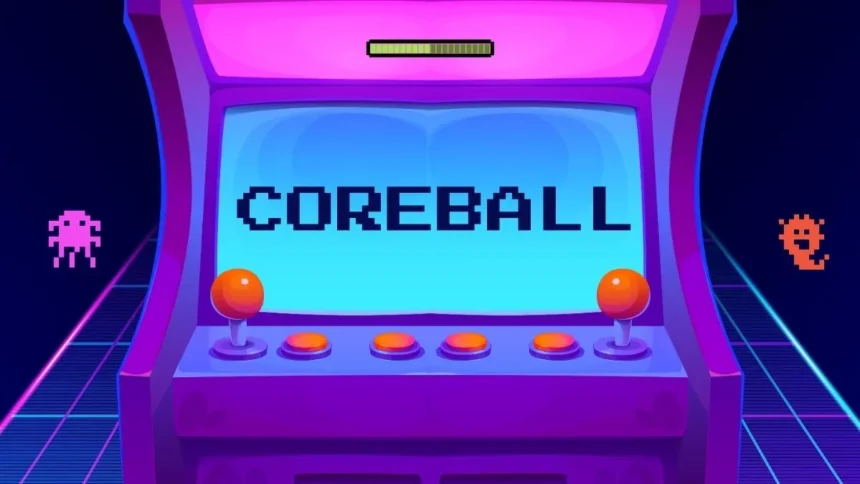
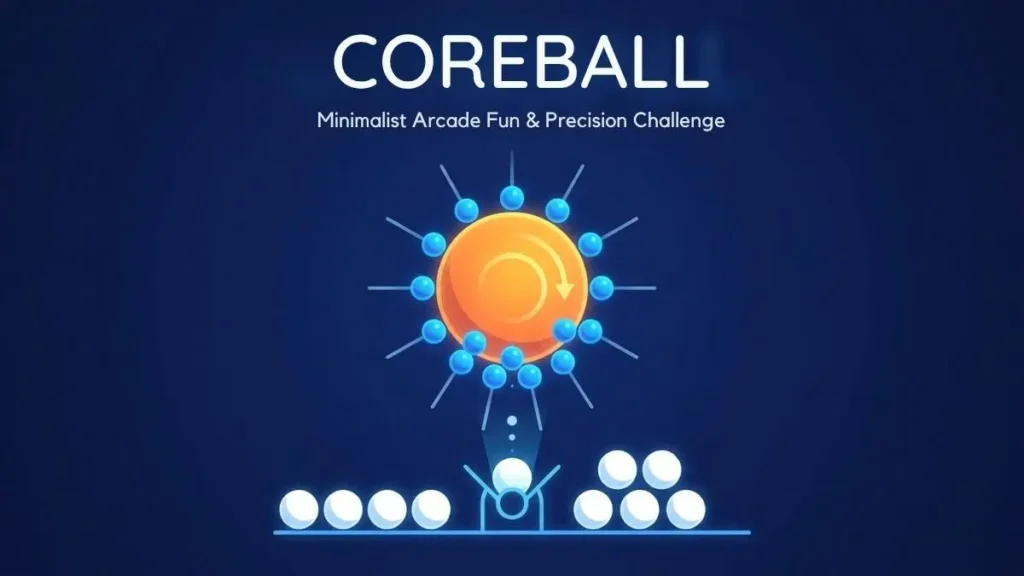
Coreball is a timing-based arcade game where players shoot small balls toward a rotating central object (the “core”). Each ball attaches to the core, forming obstacles for subsequent shots. The objective is to place all balls without colliding with any previously attached ones.
- How Gameplay Actually Progresses
- The Hidden Skill: Timing vs. Rhythm
- Practical Gameplay Insights (From Actual Play Patterns)
- Why Minimalism Works in Coreball
- Common Failure Points (And Why They Happen)
- Advanced Strategy: Playing With Intent
- Cognitive Engagement and Skill Development
- How Coreball Differs from Similar Arcade Games
- Who Will Benefit Most from Playing Coreball?
- FAQs
- Final Thoughts
There are no secondary mechanics, no power-ups, no upgrades, and no alternate modes. This single-loop design is intentional, placing full emphasis on execution rather than system complexity.
How Gameplay Actually Progresses
One of the most overlooked aspects of Coreball is how subtly its difficulty evolves. While many descriptions say that “the game gets harder,” the way it gets harder defines the experience.
Early Levels: Rhythm-Based Learning
In the first set of levels, the rotation is slow and consistent. Most players naturally fall into a rhythm, clicking at evenly spaced intervals. At this stage, success depends more on maintaining timing than reacting to change.
Mid Levels: Controlled Disruption
As levels progress, small disruptions begin to appear:
- Slight increases in rotation speed
- Tighter spacing between attached balls
- Occasional shifts in rotation direction
This is where many players first struggle. The rhythm that worked earlier becomes unreliable, forcing more conscious timing decisions.
Advanced Levels: Pattern Breakdown
At higher levels (often beyond level 35–40 in many versions), the game introduces irregular rotation behavior:
- Sudden speed changes
- Non-uniform rotation patterns
- Reduced safe gaps between balls
At this stage, reacting instinctively is no longer enough. Players must actively observe and adjust before every shot.
The Hidden Skill: Timing vs. Rhythm
A common misconception is that Coreball is about fast reflexes. In practice, it is more accurate to describe it as a timing discipline problem rather than a reaction test.
- Rhythm-based play works in early levels
- Timing-based decision-making becomes essential later
Experienced players often pause briefly between shots, even when a gap appears open. This delay allows them to confirm whether the rotation will remain consistent or shift unexpectedly.
Practical Gameplay Insights (From Actual Play Patterns)
To move beyond generic advice, it’s important to understand patterns that emerge during real gameplay:
1. Early Rhythm Can Become a Trap
Players who rely too heavily on early rhythm tend to fail in mid-level stages. The transition point is subtle, which makes it difficult to detect.
2. Larger Gaps Are Not Always Safer
At advanced levels, larger gaps may quickly rotate into tight clusters. Smaller, stable gaps are sometimes more reliable.
3. Delayed Shots Improve Accuracy
Waiting half a rotation longer than expected often results in better placement, especially when speed fluctuates.
4. Visual Focus Matters
Focusing on one reference point (such as a specific attached ball) helps track rotation more accurately than watching the entire core.
Why Minimalism Works in Coreball
Coreball’s design is intentionally minimal, but this simplicity serves a functional purpose rather than just an aesthetic one.
Reduced Cognitive Load
With no distractions on screen, players can dedicate full attention to movement and timing.
Immediate Clarity
The objective is always clear: avoid collision. No secondary goals are competing for attention.
Consistent Feedback
Every mistake is instantly visible and understandable. This clarity accelerates learning.
Common Failure Points (And Why They Happen)
Even experienced players encounter recurring issues. These are not random; they stem from predictable behavioral patterns.
Overconfidence After Easy Levels
Players often speed up their actions after a streak of successful levels, leading to avoidable mistakes.
Forced Timing
Trying to “fit” a shot into a rhythm rather than waiting for the right moment increases the risk of collision.
Ignoring Rotation Variability
In later stages, assuming consistent rotation leads to mistimed shots.
Panic Clicking
When gaps become tight, some players rush shots instead of waiting for a stable opening.
Advanced Strategy: Playing With Intent
To perform consistently at higher levels, gameplay must shift from reactive to deliberate.
Controlled Observation
Before launching a ball, watch at least one full rotation cycle. This reveals speed consistency and potential irregularities.
Shot Commitment
Once a decision is made, execute confidently. Hesitation during input often results in mis-timing.
Adaptive Timing
Instead of maintaining a fixed rhythm, adjust timing dynamically based on rotation behavior.
Mental Reset Between Levels
Short pauses between levels can significantly improve focus and reduce error accumulation.
Cognitive Engagement and Skill Development
Coreball engages several mental processes simultaneously, which contributes to its long-term appeal.
- Attention control: Sustained focus is required for accurate timing
- Pattern recognition: Identifying rotation trends improves decision-making
- Motor coordination: Synchronizing visual input with precise clicks enhances control
- Error correction: Immediate feedback helps refine strategy quickly
How Coreball Differs from Similar Arcade Games
| Element | Coreball Game | Typical Timing Games |
| Core Mechanic | Single, consistent loop | Multiple layered mechanics |
| Difficulty Progression | Subtle and pattern-based | Often linear or speed-based |
| Player Skill Focus | Timing precision | Reflex + randomness |
| Visual Design | Minimalist | Feature-rich |
Who Will Benefit Most from Playing Coreball?
Coreball is particularly suited for players who prefer:
- Short, focused gameplay sessions
- Skill-based progression without external advantages
- Minimal distractions and clear objectives
It is less suited for those seeking narrative depth or feature-rich environments.
FAQs
Q1: Is Coreball free to play?
Yes, it is a completely free-to-play browser game. It does not require any subscriptions or “pay-to-win” mechanics.
Q2: Can I play Coreball on my mobile phone?
Absolutely. Because it is built on HTML5, the game is fully responsive and works perfectly on both iOS and Android mobile browsers.
Q3: Does Coreball save my progress?
Yes, most versions of it use browser cookies to remember which level you reached, so you don’t have to start from level 1 every time you return.
Final Thoughts
The Coreball game demonstrates that complexity is not a requirement for depth. By refining a single mechanic, timed ball placement, it creates a layered experience that evolves through subtle changes in motion and spacing.
What makes Coreball stand out is not just its simplicity, but how that simplicity is used. Each level tests a player’s ability to observe, adapt, and execute with precision. The challenge is not in learning the rules, but in mastering their application under changing conditions.