


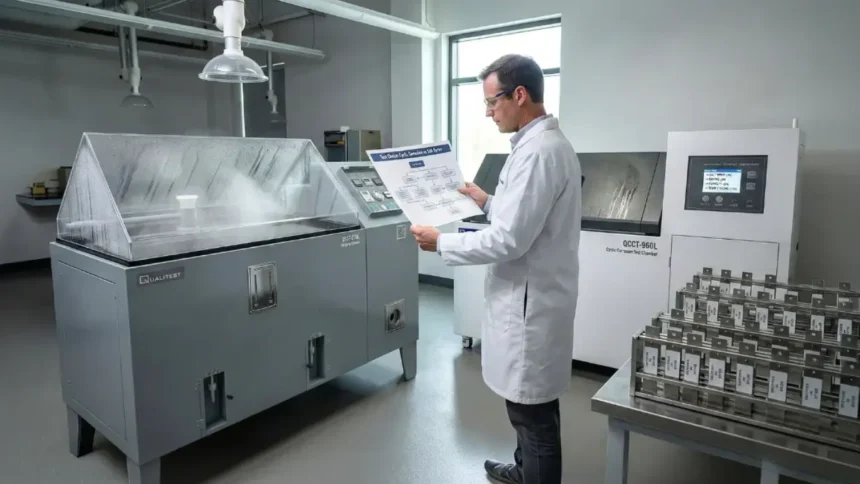
A Salt Spray Tester is a standardized corrosion-testing apparatus used primarily to evaluate and compare the corrosion resistance of coated or treated materials. By creating a controlled “salt fog” environment, these systems allow quality control teams to observe how finishes such as paints, electroplating, and galvanizing perform under accelerated conditions.
- What a Salt Spray Tester Is Actually Used For in Coating Validation
- Why Capacity Matters More Than Many Buyers Expect
- Standard Capacity Planning: How to Match Chamber Size to Your Workflow
- Salt Spray Chamber vs. Fog Cabinet vs. Salt Spray Test Chamber
- Capacity Decision Framework: Choose the Right Chamber Size
- What to Count Before You Size the Chamber
- Common Buying Mistakes in Salt Spray Capacity Planning
- When Cyclic Corrosion Is a Better Choice Than More Capacity
- Standards Buyers Commonly Align With
- Why Buyers Compare Salt Spray Testers on Qualitest
- Final Thought
While many buyers spend a significant amount of time researching specific testing standards like ASTM B117, the most common operational bottleneck in a lab is actually chamber capacity. If a chamber is too small for the daily sample load, the entire validation process slows down, delaying critical production decisions and supplier comparisons. Choosing the right size and format is the difference between an efficient, repeatable workflow and a constant testing backlog. To understand the physical dimensions and capabilities available, you can explore various Salt Spray Tester options from Qualitest.
What a Salt Spray Tester Is Actually Used For in Coating Validation
In the world of materials science, the Salt Spray Tester is fundamentally a comparative tool. It is widely used for:
- Comparative validation: Testing two different coating suppliers side-by-side to see which performs better under identical conditions.
- Coating process control: Monitoring daily production lots to ensure that pretreatment, painting, or plating processes have not drifted out of specification.
- Pass/fail screening: Providing a rapid “go/no-go” decision for batches before they leave the facility.
- Process feedback: Detecting early signs of poor adhesion or porosity in a coating before it becomes a widespread field failure.
It is important to note that a Salt Spray Chamber is not intended to predict the exact “real-world” service life of a product in years; rather, it is a standardized benchmark used to maintain a high level of coating process control.
Why Capacity Matters More Than Many Buyers Expect
In many labs, the Salt Spray Test Chamber is the most utilized piece of equipment. Capacity planning involves more than just looking at the total liter volume of the unit. It is about the physical layout of your samples and the airflow required for a valid test.
- Sample Crowding: If panels are packed too tightly to increase throughput, the salt fog cannot circulate evenly. This leads to inconsistent “dead spots” where corrosion is artificially delayed, or “shielding” where one sample protects another.
- Orientation Requirements: Many standards require panels to be held at a specific angle (e.g., 15 to 30 degrees). This orientation takes up significantly more horizontal space than vertical storage.
- Batch Efficiency: A chamber that is too small forces the lab to run multiple cycles, doubling or tripling the turnaround time for a single project.
Ultimately, capacity is about usable loading space for your specific panels, coupons, and racks.
Standard Capacity Planning: How to Match Chamber Size to Your Workflow
When evaluating a Salt Spray Chamber, it helps to categorize your needs based on volume and frequency. Common industry sizes often range from 270L and 480L up to 800L or even 1200L+ for programmable units.
Small-volume labs
A compact Fog Cabinet (such as a 270L model) is a perfect fit for R&D screening or small-scale supplier checks. If your lab only needs to validate a few panels per week or small batches of fasteners, a smaller unit saves valuable floor space and utilizes fewer consumables (salt and deionized water) per run.
Mid-volume QC labs
For routine production acceptance, a mid-sized Salt Spray Test Chamber (around 480L to 800L) is generally the sweet spot. These units provide enough room to validate multiple lots simultaneously without crowding, making them ideal for automotive suppliers or paint shops that need to clear several batches every 24 to 48 hours.
High-volume or multi-program labs
Centralized corrosion labs or large-scale manufacturers often require programmable models with capacities exceeding 1000L. These high-capacity systems allow for multiple projects to run in parallel and offer the flexibility to handle larger components or higher panel counts without creating a bottleneck in the validation pipeline.
Salt Spray Chamber vs. Fog Cabinet vs. Salt Spray Test Chamber
Buyers often encounter different terminology during the procurement process, though these terms often refer to the same family of equipment:
- Salt Spray Chamber: The most common technical term used in procurement and industry standards.
- Fog Cabinet: An older, descriptive term emphasizing the “fog” or mist environment created inside the enclosure.
- Salt Spray Test Chamber: A more formal designation typically found in technical specifications, tender documents, and rigorous quality manuals.
Regardless of the name, the goal is the same: providing a stable, corrosive atmosphere for coating validation.
Capacity Decision Framework: Choose the Right Chamber Size
To help you decide, consider the following “choose this when” scenarios:
Choose a smaller standard Salt Spray Chamber when:
- You handle low daily sample counts or occasional QC batches.
- You are primarily focused on R&D or comparing new supplier samples.
- Lab floor space is limited and utilization is more important than massive batch loading.
Choose a mid-range chamber when:
- You have a routine daily production volume that requires validation.
- You need to compare multiple coating variants or production lots in a single cycle.
- You want a balance between cost, footprint, and throughput.
Choose a larger or programmable Salt Spray Test Chamber when:
- You have a high volume of panels that must be processed daily.
- You need to reduce the “wait time” between batches for large-scale programs.
- You require advanced control over the test environment for more complex or varied standards.
What to Count Before You Size the Chamber
Before requesting a quote, perform a quick audit of your expected workflow using this checklist:
- Panel Count: How many samples do you typically run per cycle?
- Maximum Dimensions: What is the size of your largest panel or part?
- Spacing Needs: How much gap is required between samples per your internal or customer standards?
- Rack Design: Do you use standard slots or custom fixtures that might consume more chamber volume?
- Batch Frequency: Will the chamber run 24/7 or only a few days a week?
- Growth Factor: Do you anticipate a 20% or 50% increase in test volume over the next two years?
Common Buying Mistakes in Salt Spray Capacity Planning
- Liters vs. Layout: Buying based on liter volume alone without checking if your specific racks and panels will actually fit.
- The “Just Enough” Trap: Buying a chamber that perfectly fits today’s needs, leaving zero room for production increases or new projects.
- Ignoring Programmability: Focusing only on size while ignoring that programmable features can improve the efficiency of those high-capacity runs.
- Underestimating Consumables: A massive chamber for a tiny sample load is inefficient in terms of water and salt usage.
- Misunderstanding the Purpose: Treating the Salt Spray Tester as a real-world longevity predictor instead of the comparative process-control tool it is.
When Cyclic Corrosion Is a Better Choice Than More Capacity
Sometimes, the frustration with salt spray testing isn’t about the volume of samples, but the “realism” of the results. If your coatings pass salt spray but fail in the field, moving to a larger Salt Spray Tester will not fix the issue.
Cyclic corrosion testing is often the better choice when you need a more accurate simulation of natural outdoor environments. While a standard Fog Cabinet provides a constant, high-humidity salt mist, cyclic chambers can alternate between salt spray, drying, and humidity cycles. If your goal is durability prediction rather than simple process screening, you should evaluate whether you need more capacity or a different testing method altogether.
Standards Buyers Commonly Align With
While capacity dictates your throughput, standards dictate your parameters. Most chambers are designed to meet:
- ASTM B117 (The most common salt spray standard)
- ISO 9227 (The international standard for corrosion tests)
- ASTM G85 (Modified salt spray testing)
- DIN 50021 (German standard for salt spray)
Aligning with these standards ensures your validation results are accepted by global customers, but remember that the standard tells you how to test—only capacity planning tells you how much you can test.
Why Buyers Compare Salt Spray Testers on Qualitest
Qualitest offers a diverse range of corrosion-testing solutions, from standard Salt Spray Chamber models to advanced programmable and cyclic corrosion systems. By framing the selection around practical coating validation and process control, their lineup helps buyers identify the specific capacity—be it 270L or 1280L—that fits their actual lab throughput. This pragmatic approach to equipment selection ensures that the Salt Spray Tester remains an asset to production rather than a bottleneck in the quality department.
Explore Salt Spray Tester options from Qualitest and request a quote for the Salt Spray Chamber, Fog Cabinet, or Salt Spray Test Chamber capacity that fits your coating validation workflow.
Final Thought
The most effective Salt Spray Tester is the one that supports your lab’s daily volume without compromise. By focusing on capacity planning—including panel layout, spacing, and batch frequency—you can select a Salt Spray Chamber that ensures your coating validation remains on schedule. Start by defining your current and future sample loads, then compare the various chamber sizes available through Qualitest to find the perfect fit for your quality control mission.