

The conventional wisdom in large organizations is that speed and governance exist in permanent tension. Move fast and you compromise controls. Enforce controls and you slow everything down. Most enterprise teams accept this trade-off as a structural fact of organizational life rather than a problem that can be solved. But the teams inside large organizations that consistently move faster than their peers have discovered something important: the bottlenecks are almost never caused by the governance requirements themselves.
- Protecting institutional knowledge at scale with Lark Wiki
- Large-scale collaboration without the chaos with Lark Meetings
- Live operational visibility with Lark Base
- Approvals that move at the speed of the business with Lark Approval
- Turning documents into action with Lark Docs
- Bonus: Where enterprise agility is actually lost
- Conclusion
They are caused by governance systems that were not designed to scale. When the tools that enforce oversight are also the tools that enable execution, speed and control stop being opposites. That is the operating principle behind the most effective project management tools in enterprise environments today.
Protecting institutional knowledge at scale with Lark Wiki
Enterprise knowledge bases fail in predictable ways. They start well-organized, grow without structure, become unnavigable, and are eventually abandoned in favor of email chains and personal drives. Lark Wiki is built to resist that pattern by giving large organizations the tools to maintain knowledge quality as the content volume and the team size both grow.
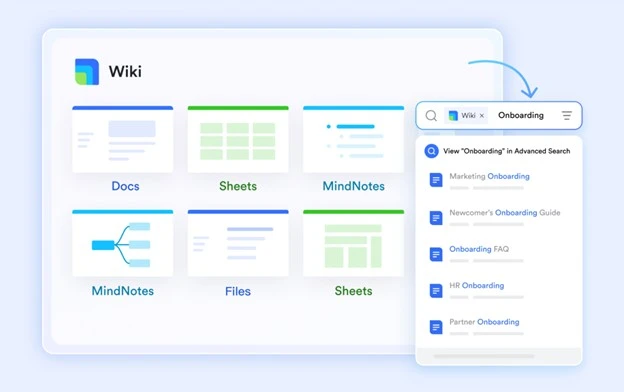
- “Permission Settings” at user and department level. Administrators can set view, edit, copy, and export permissions on any page, space, or section of the Wiki at a granular level. Sensitive materials stay protected while broadly relevant content remains accessible, without requiring a separate access management system to sit alongside the knowledge base.
- “Migration” from Confluence, Word, Excel, and XMind. Enterprise teams with existing documentation can import content into Lark Wiki using available migration tools, including support for Confluence. This reduces the need for manual recreation in most cases. However, some styles, formatting, or large attachments may not transfer perfectly and could require manual adjustments after migration.
The result: The Wiki becomes a living operational reference rather than an archive. Knowledge that was previously locked in individual inboxes or inaccessible legacy systems becomes searchable and current, and the access model ensures that the right people can find it without compromising the security requirements that enterprise governance demands.
Large-scale collaboration without the chaos with Lark Meetings
Enterprise meetings carry a complexity that standard video conferencing tools struggle to handle. A global all-hands, a cross-functional strategy session, or a company-wide training event requires an infrastructure that can manage hundreds of participants, facilitate structured small-group discussion, and keep everyone engaged without losing the conversational quality of a smaller call. Lark Meetings is built for that range.
- “Group Meetings” with up to 500 participants and 50 breakout sessions. A single Lark meeting can hold the entire enterprise team and simultaneously divide into up to fifty separate breakout groups for parallel discussion, then reconvene. No platform switch is required and no parallel logistics are needed to manage the smaller groups.
- “Real-time Auto Translation” for live subtitles. For global enterprise teams communicating across language boundaries, Lark Meetings provides real-time subtitle translation during live calls. Participants can follow the conversation in their own language without waiting for a post-meeting translated transcript.
The result: Enterprise-wide events run with the scale of a broadcast and the quality of a conversation. Large teams can gather, divide into working groups, and reconvene without the coordination overhead that typically makes organization-wide meetings feel like logistical exercises rather than productive sessions.
Live operational visibility with Lark Base
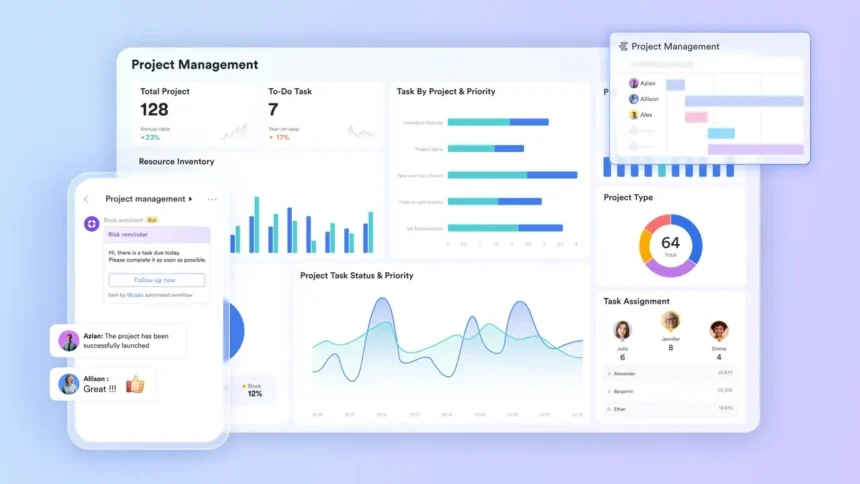
Enterprise operations teams spend a disproportionate amount of time producing reports rather than acting on them. The data exists across multiple systems, someone has to compile it, format it, and present it on a cycle that is always slightly behind the decisions it is meant to inform. Lark Base replaces that cycle with a live operational view that updates itself.
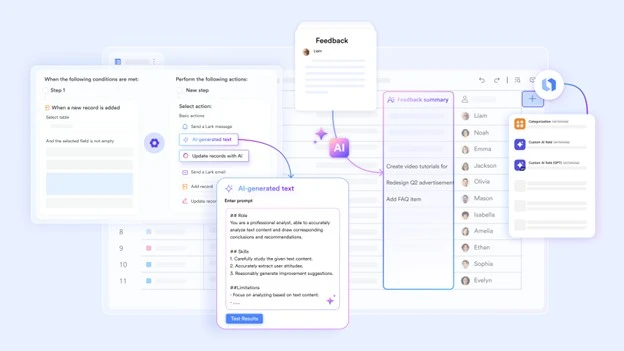
- Shared dashboards for cross-departmental visibility. Lark Base dashboards can be shared across departments so that all stakeholders see the same live data simultaneously. A head of operations and a regional director in a different time zone are both looking at the same numbers, removing the version discrepancy that drives most “let me check the latest figures” delays.
- Automated status-change notifications to Messenger. When any record in Base changes status, relevant team members receive an automatic notification in Messenger. The information flows to where the decision-makers are without requiring anyone to generate or distribute a report.
The result: Reporting stops being a dedicated activity and becomes a continuous background process. The operational team’s time shifts from compiling information to acting on it, which is where enterprise agility is actually won or lost.
Approvals that move at the speed of the business with Lark Approval
In large organizations, approval processes are necessary but often badly designed. They create accountability without creating speed, because the routing logic is built for compliance rather than efficiency. Lark Approval is designed to satisfy both requirements simultaneously.
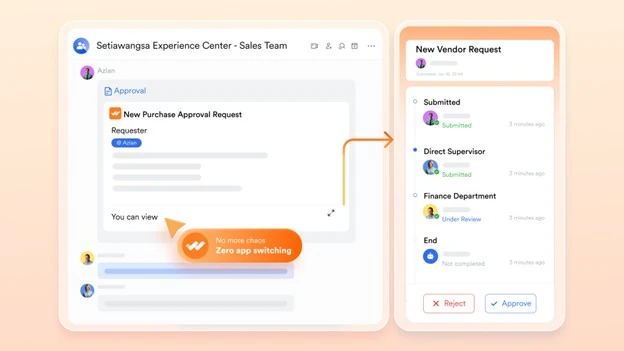
- “Conditional Branches” for automatic escalation routing. Approval workflows can be configured to escalate automatically when a request meets defined criteria, such as a budget threshold, a compliance flag, or a department designation. The right approver receives the right request without anyone manually redirecting it, and the audit trail records every routing decision for governance purposes.
- “Approval Notifications” across all devices. Approvers receive notifications wherever they are working, on desktop, mobile, or within Messenger. Time-sensitive requests don’t wait for someone to check a system they only visit occasionally.
The result: Governance requirements are met automatically by the routing logic rather than manually by an administrator. Approvals move faster because the system does the compliance work, and the audit trail that regulators and internal risk teams require is maintained as a byproduct of normal operations.
Turning documents into action with Lark Docs
Enterprise documents fail at the same point: they are produced, reviewed, and filed, but the actions they were supposed to generate never get formally captured or tracked. Lark Docs changes the relationship between documentation and execution by making documents an active part of the workflow rather than a record produced after the work is done.
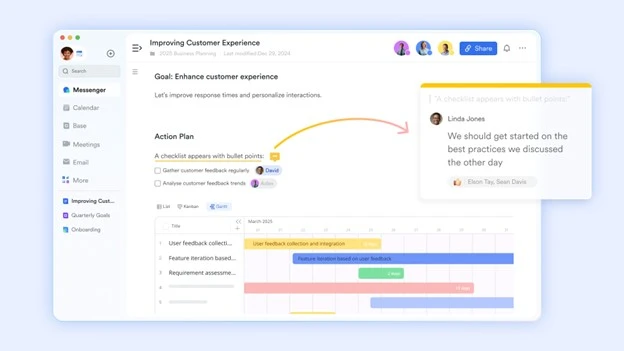
- “Comment” with thread resolution for structured review. Every comment on a Lark Docs can be addressed and marked resolved, creating a visible record of every feedback point and its outcome. For legal reviews, policy approvals, or compliance documentation, this provides a built-in audit trail of the review process.
- “@mention” for in-document action assignment. Any team member mentioned in a document is notified immediately and can respond from within the document. Actions created during a review are owned, dated, and visible to anyone with access, without requiring a separate task management system to track them.
The result: Documents become the place where accountability is established, not just where work is described. The enterprise team gains a documentation layer that enforces follow-through by design rather than depending on individuals to manually transfer action items from documents to task trackers.
Bonus: Where enterprise agility is actually lost
When large organizations audit their operational speed, the bottlenecks almost always trace back to the same root cause: information that should be visible is not, and approvals that should be automatic are manual. The leadership team evaluates Google Workspace pricing and similar platforms as the baseline infrastructure, then adds governance tools on top. The result is a system where the work platform and the oversight platform are separate, and coordination between them requires dedicated operational staff.
Lark collapses that structure. The governance layer lives inside the same environment as the execution layer, so the compliance overhead does not sit on top of the work but runs alongside it. Approvals happen in the same platform as the documents that triggered them. Access controls are built into the knowledge base rather than managed separately. Audit trails are generated by the tools the team uses every day rather than by a parallel compliance system.
Conclusion
Enterprise agility is not about removing governance. It is about building governance into the infrastructure so that it accelerates decisions rather than delaying them. Large organizations that operate on a unified set of productivity tools where oversight and execution share the same environment move faster than their peers not because they have relaxed their controls, but because their controls no longer require a separate system to enforce them.