


AIA billing is a standardized progress billing system used throughout the construction industry to document, track, and request payment for work completed on a project. Developed by the American Institute of Architects (AIA), it provides a structured method for contractors, project owners, lenders, and construction managers to monitor project progress and verify payment requests.
Unlike a traditional invoice that simply lists services provided, AIA billing ties payment directly to measurable project progress. Every payment application is supported by detailed documentation showing completed work, stored materials, previous payments, retainage, and the remaining contract balance.
Why AIA Billing Matters
Construction projects often span months or years, making lump-sum invoicing impractical. Owners need assurance that work has actually been completed before releasing funds, while contractors need predictable cash flow to keep projects moving.
AIA billing solves both problems by creating a common framework that everyone involved can understand and verify.
The Core Components of AIA Billing
At the heart of the process are standardized forms that organize financial and project information.
Schedule of Values (SOV)
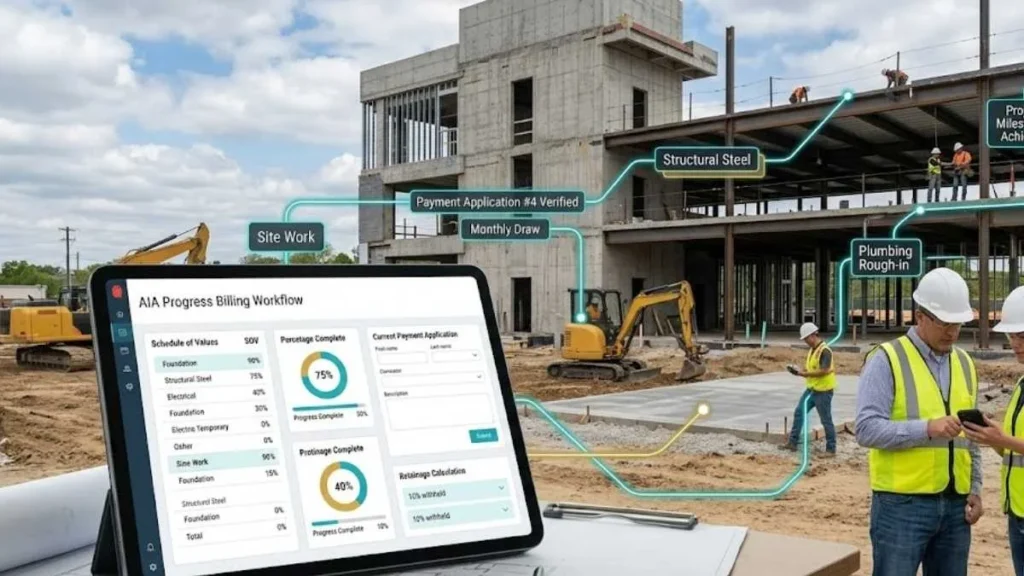
The Schedule of Values serves as the project’s financial roadmap.
Before construction begins, the contractor breaks the total contract amount into individual cost categories such as:
- Site work
- Concrete
- Structural steel
- Electrical systems
- Plumbing
- Interior finishes
Each category receives a dollar value representing its share of the overall contract.
As work progresses, payments are calculated against these predefined values.
Application and Certificate for Payment
The payment application summarizes project progress and calculates the amount currently due.
It typically includes:
- Original contract amount
- Approved change orders
- Work completed to date
- Stored materials
- Retainage withheld
- Previous payments received
- Current payment requested
This creates a clear financial snapshot for everyone involved.
Understanding the G702 and G703 Forms
When people discuss AIA billing, they are often referring to two widely recognized forms.
| G702 | G703 |
| Total contract value Work completed Materials stored on-site or in approved storage locations Retainage calculations Net amount due | Scheduled value Previous work completed Current billing amount Percentage complete Remaining balance |
How the AIA Billing Process Works
The process follows a predictable monthly cycle.
Step 1: Establish the Schedule of Values
The contractor creates and submits the Schedule of Values for approval.
Accuracy at this stage is critical because every future payment application depends on these allocations.
Step 2: Track Project Progress
Throughout the month, project teams document completed work and approved stored materials. Field reports, inspections, delivery tickets, and progress photos often support these records.
Step 3: Prepare the Payment Application
At the end of the billing period, the contractor updates the G702 and G703 forms based on actual progress.
Step 4: Review and Approval
The architect, owner’s representative, or construction manager reviews the application to verify accuracy. Questions or discrepancies are typically resolved before approval.
Step 5: Payment Release
Once approved, payment is processed according to contract terms. The cycle then repeats for the next billing period.
Retainage and Why It Matters
One unique feature of AIA billing is retainage. Retainage is a percentage of each payment withheld until project completion. Common retainage rates range from 5% to 10%, depending on contract requirements.
Owners use retainage as a safeguard to ensure work is completed satisfactorily and punch-list items are resolved. For example, if a contractor submits a $100,000 payment application with 10% retainage, only $90,000 is paid immediately. The remaining $10,000 is held until agreed project milestones or completion.
Common AIA Billing Mistakes
Reporting inaccurate percentages of completion can create trust issues and delay approvals. An overly detailed or overly simplified Schedule of Values often confuses the project.
Stored materials, change orders, and completed work should always be supported by proper records. Unapproved or undocumented changes can lead to payment disputes and reconciliation problems later.
Small calculation mistakes can trigger lengthy review cycles and payment delays.
Best Practices for Contractors
Successful contractors treat AIA billing as more than an administrative task.

Consider these proven practices:
- Update project records continuously rather than at month-end.
- Align field reporting with billing categories.
- Submit applications before deadlines.
- Track approved and pending change orders separately.
- Maintain detailed documentation for stored materials.
- Review calculations carefully before submission.
- Communicate proactively with owners and architects regarding project progress.
Organizations that establish disciplined billing procedures typically experience faster approvals and fewer disputes.
Frequently Asked Questions
What is the difference between AIA billing and a standard invoice?
A standard invoice requests payment for goods or services. AIA billing provides detailed documentation showing percentages of completion, retainage, stored materials, and remaining contract balances.
Who reviews AIA payment applications?
Depending on the contract, reviews may be performed by architects, owners, construction managers, lenders, or multiple stakeholders.
What happens if a payment application is rejected?
The reviewer identifies discrepancies or missing information, and the contractor revises and resubmits the application for approval.
Conclusion
AIA billing remains one of the most effective systems for managing construction payments because it combines financial accountability with project transparency. By connecting payment requests directly to documented progress, it gives owners confidence, helps lenders monitor risk, and provides contractors with a structured path to maintaining cash flow.
Whether you’re a general contractor, subcontractor, project manager, or owner, understanding how AIA billing works and mastering the G702, G703, and Schedule of Values process can significantly reduce disputes, improve payment accuracy, and contribute to a smoother construction project from start to finish.