


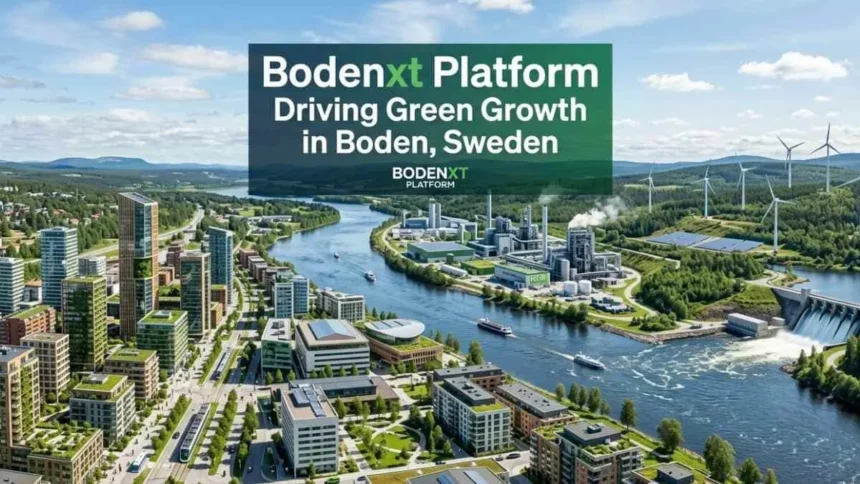
Bodenxt is the Municipality of Boden’s framework for managing the rapid green transformation of the entire community, not the name of a steel company or a single industrial project. The municipality created five areas of work around skills supply, housing and living, business development, and infrastructure above and below ground because Boden expects a development leap equivalent to roughly 20 years within only a few years.
The distinction matters because Stegra is the industrial accelerator, while Bodenxt is the municipal response. Stegra’s green steel establishment is creating demand for workers, housing, transport and supporting businesses; Bodenxt exists to coordinate the wider changes that follow from that demand.
This makes Bodenxt unusual: its success cannot be measured simply by how much industrial capacity is built. The harder test is whether Boden can add homes, skills, utilities, transport and local economic capacity quickly enough that industrial growth does not become constrained by the town around it.
Why Did Boden Need Bodenxt?
Boden is not simply adding one employer. The municipality is dealing simultaneously with green industry, population growth and an expanding defence presence. The resulting pressure reaches parts of the community that would not normally be considered part of an industrial project, particularly housing, schools, recruitment, roads and municipal services.
The scale becomes clearer when looking at Stegra. Boden Municipality reported that the project was expected to bring approximately 400 new residents to Boden during 2025 alone, while Stegra’s workforce was expected to reach around 1,500 initially and approximately 2,000 later. Those workers also create indirect demand in retail, services, construction and public-sector employment.
That creates a chain reaction:
Industrial investment → new jobs → population growth → housing demand → infrastructure demand → pressure on public services → new opportunities for local businesses.
Bodenxt is designed around that chain rather than treating each consequence as a separate municipal problem.
Bodenxt Is Not Stegra
This is the most important distinction for anyone researching Bodenxt.
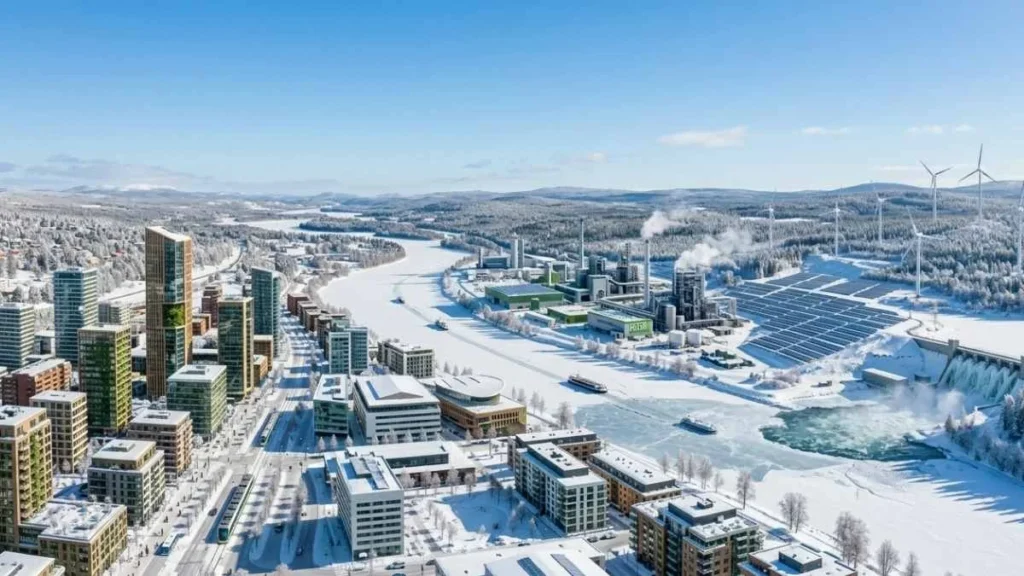
Stegra is building its large-scale green steel operation in Boden Industrial Park, a 550-hectare industrial area. The municipality describes the site as Sweden’s largest industrial area and says it has conditions suited to electricity-intensive and land-intensive green industries.
Bodenxt therefore should not be described as “Boden’s green steel project.” That description misses most of what the program does.
The Five Problems Bodenxt Is Trying to Solve
1. Skills: Can Boden Find Enough People?
The first bottleneck is not necessarily unemployment; it is the availability of people with the right technical skills.
Boden has responded by changing education alongside the labour market. From autumn 2026, Björknäsgymnasiet is introducing a fourth technical year built around industrial design and product development, combining classroom learning with project work and workplace-based learning. The municipality explicitly links the program to new industrial and defence-related skill requirements.
That is a more significant Bodenxt response than simply advertising vacancies. Training a local pipeline can reduce dependence on importing every technician, engineer and operator from elsewhere.
There is also a hidden challenge: recruitment does not end when someone accepts a job. The worker needs housing, transport and services, and often a partner or family needs them too. A technically successful recruitment strategy can therefore fail if the surrounding community cannot accommodate the people it attracts.
2. Housing: The Constraint Already Showing Up
Housing is arguably Bodenxt’s clearest real-world stress test.
In May 2026, the municipality reported that the vacancy rate for rental apartments was close to zero. Eleven detailed development plans were already enabling approximately 1,300 apartments and 500 detached houses, yet construction remained slow because of high construction costs, financing uncertainty and weak project economics.
This creates an important distinction between planning capacity and actual housing supply.
Having land and approved plans does not automatically produce homes. If developers cannot finance construction at viable costs, a municipality can have sufficient zoning capacity while residents still cannot find an apartment.
The problem also affects people already living in Boden. A tight housing market makes it harder for young people to obtain their first home, older residents to downsize, and families to move when their circumstances change. The shortage therefore reduces housing-market mobility inside the municipality, not only the ability of newcomers to enter it.
3. Business Development: Turning One Investment into an Ecosystem
The strongest economic outcome would not be thousands of people working for one industrial company. It would be the creation of a broader supplier and service ecosystem around the industrial base.
That can include maintenance companies, engineering services, construction contractors, logistics providers, restaurants, accommodation, technical consultants and other specialist businesses.
Boden’s 2026 business-climate results show why this matters. The municipality remained among Norrbotten’s strongest business environments, receiving an overall score of 3.9 and ranking 84th nationally, but local businesses identified housing, skills and infrastructure as critical conditions for continued growth.
In other words, business development is constrained by the same bottlenecks affecting industrial recruitment. A shortage of workers or premises can prevent a small local supplier from expanding even when customer demand is increasing.
4. Infrastructure Above Ground: The Railway Test
The new railway to Boden Industrial Park provides one of the clearest examples of Bodenxt turning an industrial requirement into wider infrastructure.
The railway includes approximately six kilometres of track and nine bridges and connects the industrial park to the Malmbanan railway and Sweden’s national rail network. It was completed one month ahead of schedule and under budget and was officially inaugurated in June 2026.
The important point is not simply that Boden built a railway.
The railway changes the development equation because heavy, long-distance freight can move more efficiently while the industrial park becomes more attractive to additional companies. The municipality has also been developing a complementary road connection, with one section planned for 2026 and another toward Highway 605 planned for 2027.
This illustrates a key Bodenxt principle: infrastructure built for one major establishment can become shared economic infrastructure for the next generation of businesses.
5. Infrastructure Below Ground: The Less Visible Bottleneck
Roads and railways are easy to photograph. Water, wastewater, electricity and industrial utility capacity are harder to see but can determine whether development is physically possible.
Boden’s strategic planning documents identify the need for major investments in water and wastewater capacity to accommodate expected population growth. They also note that financing these investments can require increased borrowing or other funding mechanisms.
There is another less obvious constraint: electricity capacity.
A municipal audit of the societal transformation identified available electrical capacity as a significant limitation and highlighted the need to find businesses capable of using residual energy and materials from the steel plant and other activities.
That points toward a more sophisticated version of the green-industrial model: the objective is not merely to produce low-carbon steel, but to develop industrial relationships in which energy, materials and infrastructure can be used efficiently by multiple businesses.
The Overlooked Part of Bodenxt: Timing
Bodenxt’s real challenge is synchronization.
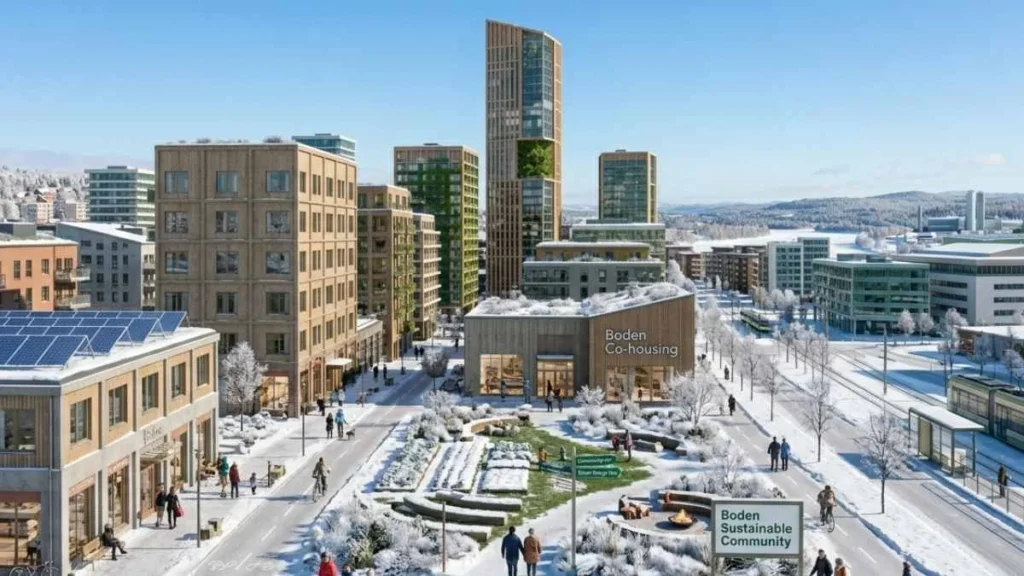
A new industrial facility can be built according to an engineering schedule. A city cannot expand with the same simplicity because housing, education, utilities, planning approvals, public services and workforce decisions have different lead times.
Boden’s housing situation demonstrates the problem. The municipality already has plans capable of enabling thousands of homes, yet actual construction is being slowed by financing and construction costs.
That means “planned capacity” and “available capacity” are not the same thing. For Bodenxt, the difference between those two numbers can determine whether projected population growth materializes.
A Second Overlooked Issue: Who Pays for the Transformation?
Green industrial investment can generate substantial economic benefits, but the costs of preparing a municipality do not necessarily fall on the same organizations that receive the greatest commercial benefit.
Boden’s strategic planning explicitly identifies an asymmetry between the actors required to make investments and the actors benefiting economically from the transformation. It also stresses the importance of state involvement in infrastructure such as rail and power supply.
This is an important policy issue. A municipality may need to expand infrastructure before increased tax revenue or population growth fully materializes. That creates a financing gap during the most critical stage of transformation.
What Bodenxt Reveals About Green Industrial Cities
Bodenxt demonstrates that green industrialization is not simply an engineering problem.
A low-carbon steel plant can reduce industrial emissions, but the surrounding city still needs:
- workers with relevant technical skills
- affordable and available housing
- Transport capacity
- water and wastewater systems
- electricity infrastructure
- local suppliers
- schools and public services
- mechanisms for financing rapid development
Boden’s experience is particularly useful because some of these pressures are already measurable rather than hypothetical. Rental vacancies are near zero, housing construction is struggling to keep pace, new technical education is being introduced, and major rail infrastructure has already been delivered.
Is Bodenxt a Model for Other Cities?
Bodenxt should not be copied as a fixed template because every industrial region has different housing markets, infrastructure and labour pools. Its more transferable lesson is the sequence of questions it forces a municipality to answer before industrial growth overwhelms local capacity.
A city considering a major industrial investment should ask:
- Where will the new workforce live within the first two years?
- Which occupations will become scarce first?
- Which infrastructure must exist before factories begin operating?
- Which local companies can become suppliers rather than spectators?
- Who finances infrastructure whose benefits arrive years later?
- What happens if population growth exceeds the original forecast?
Boden’s current experience shows why these questions cannot be postponed until the industrial project is nearly complete.