


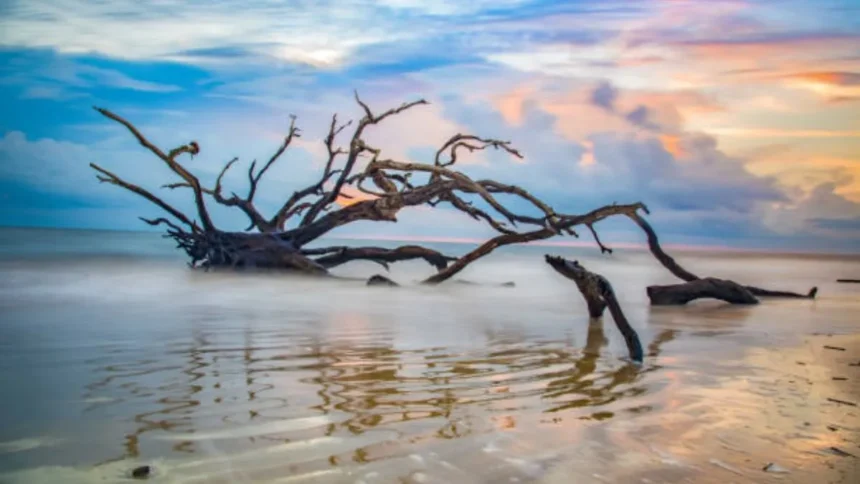
Driftwood Beach is located on the northern end of Jekyll Island, part of Georgia’s Golden Isles. Beachview Drive leads to the beach, with a public parking area near the access point. Jekyll Island is a barrier island, so waves, tides, storms, wind, erosion, and sediment movement naturally shape its shoreline.
- Why Does Driftwood Beach Have So Many Trees?
- Why the Beach Looks Different from One Visit to Another
- When Should You Visit Driftwood Beach?
- The Photography Mistake Most Visitors Make
- Is Driftwood Beach Good for Swimming?
- What Should You Wear and Bring?
- Can You Bring a Dog to Driftwood Beach?
- What Should You Never Do at Driftwood Beach?
- Driftwood Beach vs. a Conventional Beach
- Is Driftwood Beach Worth Visiting?
- FAQs
The location matters because it explains why Driftwood Beach looks so different from a conventional recreational beach. The shoreline has migrated over time, exposing areas that previously supported coastal vegetation. The Jekyll Island Authority has documented substantial changes in this part of the island, including historical shoreline movement associated with erosion.
Visitors therefore shouldn’t assume that today’s arrangement of trees is permanent. A famous photograph from several years ago can show a shoreline configuration that no longer exists.
Why Does Driftwood Beach Have So Many Trees?
The trees are primarily the remains of maritime forest affected by coastal erosion. When the shoreline moves landward, trees that were previously separated from the ocean can become exposed to saltwater, wave action, and unstable sandy conditions.
Once the trees die and fall, their trunks and roots can remain visible for years. Their pale, weathered appearance results from prolonged exposure to sunlight, saltwater, moisture, and physical abrasion.
The important point is that the beach is showing a sequence of coastal changes:
forest → shoreline retreat → tree exposure → tree death → fallen trunks → continued weathering.
That sequence is why the trees are more than scenery. They allow visitors to see the physical consequences of shoreline movement without needing a geological diagram.
Why the Beach Looks Different from One Visit to Another
Driftwood Beach is a particularly poor place to rely on a single online photograph when planning a visit. Barrier-island beaches are dynamic, and storms can move sand, alter small channels, expose buried roots, and change how water surrounds individual trees.
This also explains an interesting photographic phenomenon: the same tree can produce completely different photographs under different tidal conditions.
At lower water levels, more sand and roots may be exposed. At higher water levels, water can surround the trunks, create reflections and eliminate portions of the foreground. After a storm, the arrangement may change again.
For repeat visitors, this is part of the attraction. You aren’t necessarily returning to photograph the same composition; you’re photographing a coastline in a different physical state.
When Should You Visit Driftwood Beach?
The answer depends on what you want from the visit, not a universal “best time.”
For sunrise photography
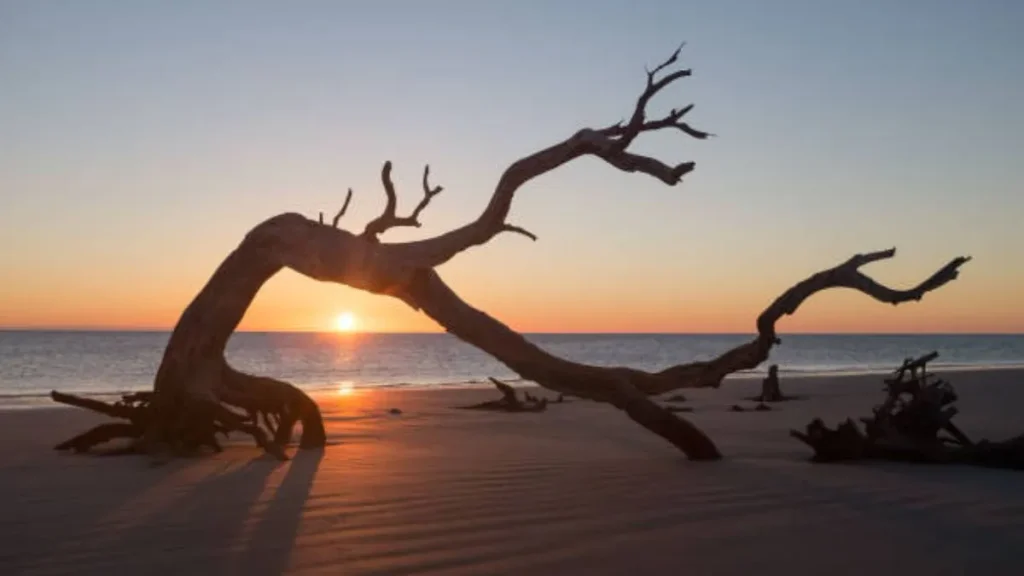
Arrive before sunrise, not at sunrise. The advantage isn’t just the golden light. Arriving early gives you time to choose a composition before the sky gets bright enough to flatten silhouettes.
Look for one dominant trunk rather than trying to include every tree. A single large trunk can act as the foreground subject while the ocean and horizon provide depth behind it.
For reflections
Pay attention to tide timing. Wet sand and shallow water can create reflective surfaces around the roots, but the amount of exposed beach changes throughout the tidal cycle.
This is one reason photographers should check the tide forecast instead of treating sunrise or sunset time as the only planning variable.
After significant weather
A recent storm can produce a different visual landscape, but it also introduces uncertainty. Fallen branches, unstable surfaces, high surf, or altered access conditions can make exploration less comfortable.
The mistake is assuming that “after a storm” automatically means better photography. It can mean a more interesting landscape, but you should assess conditions before walking onto the beach.
The Photography Mistake Most Visitors Make
The obvious approach is to photograph the largest tree you can find. That often produces a technically attractive photograph but a visually confusing one because Driftwood Beach contains so many competing shapes.
A better approach is to establish a hierarchy:
- Choose one trunk or root system as the primary subject.
- Use smaller branches to direct the eye toward the ocean.
- Keep the horizon level unless a deliberate tilt improves the composition.
- Check the edges of the frame for stray branches.
- Recheck the foreground after changing your position.
Moving only a few feet can make a major difference because roots and branches overlap differently from each viewpoint.
A wide-angle lens can capture the scale of the landscape, but it doesn’t automatically create better photos. Composition determines whether the abundance of trees looks intentional or cluttered.
Is Driftwood Beach Good for Swimming?
Not particularly if swimming is your main objective.
The exposed trunks, roots, uneven sand, and changing shoreline make Driftwood Beach better suited to walking, sightseeing, nature observation, and photography than to the straightforward swimming experience people usually associate with an open sandy beach.
Jekyll Island has other public beaches where open shoreline and conventional beach recreation are more practical. This distinction matters when planning a family outing: don’t choose Driftwood Beach solely because it is the island’s most recognizable beach.
Choose it when the unusual landscape itself is the reason for going.
What Should You Wear and Bring?
The terrain deserves more attention than the word “beach” suggests. Exposed roots and irregular ground can make walking different from walking across a smooth sandy shoreline.
Useful items include:
- Water
- Sun protection
- Comfortable footwear
- A phone or camera with sufficient battery
- A small bag for personal belongings
- Tide and weather information before leaving
If you’re carrying camera equipment, don’t assume every flat-looking surface is suitable for placing a bag. Sand, damp wood, and incoming water can turn a convenient spot into a poor place to put equipment.
Can You Bring a Dog to Driftwood Beach?
Yes. Dogs are permitted at Driftwood Beach but must remain under immediate control and on a leash no longer than 16 feet, according to Jekyll Island’s official beach guidance.
The leash rule matters because the beach is also part of a sensitive coastal environment. Dogs should not roam into dunes or protected areas.
If you’re visiting during sea turtle nesting season, additional wildlife protections become relevant. Jekyll Island has sea turtles, and visitors must follow rules concerning lighting and disturbance during the nesting period.
What Should You Never Do at Driftwood Beach?
The biggest mistake is treating the dead trees as disposable material.
Don’t cut, break, carve, or remove pieces of the trees. Their presence is part of the natural coastal system that makes the beach distinctive.
Also avoid climbing unstable trunks. A tree can look solid while internal decay has weakened it. Saltwater exposure, repeated wetting and drying, insects, and years of weathering can compromise wood without making the damage obvious from the outside.
Stay out of dune vegetation and follow posted restrictions. Dunes help store sand and provide important habitat; walking through them can damage vegetation that helps stabilize the coastal environment.
Driftwood Beach vs. a Conventional Beach
The easiest way to decide whether Driftwood Beach fits your plan is to match the beach to your objective.
| Your main goal | What Driftwood Beach offers |
| Landscape photography | Excellent subject variety from trees, roots, sand, and water |
| Sunrise or sunset | Strong compositions when light and tide cooperate |
| Swimming | Less convenient than an open sandy beach |
| Nature observation | Direct view of coastal erosion and maritime forest remnants |
| Family beach day | Better options may exist elsewhere on Jekyll Island |
| Quiet exploration | Best when you plan around tides and visitor numbers |
| Understanding coastal erosion | An unusually visible real-world example |
This distinction prevents a common planning error: choosing a destination because its photographs are famous without considering what those photographs actually represent.
Is Driftwood Beach Worth Visiting?
Driftwood Beach is unusual because its most recognizable feature also shows environmental change. The fallen trees aren’t merely attractive objects; they reveal where the maritime forest once stood and how the shoreline has shifted.
Visit at low or change tide if you want to explore the exposed roots. Plan around sunrise or sunset if photography matters but check tide and weather conditions rather than following a fixed “best time” recommendation. If swimming is the priority, consider another Jekyll Island beach.
The most rewarding way to experience Driftwood Beach is to notice the process behind the landscape. Every exposed root, weathered trunk, and changing patch of sand is part of a coastline that is still moving.
FAQs
1. Where is Driftwood Beach?
Driftwood Beach is on the northern portion of Jekyll Island, Georgia, along Beachview Drive. Parking is available near the public beach access.
2. Why are the trees at Driftwood Beach dead?
They are remnants of maritime forest affected by shoreline erosion and changing coastal conditions. As the shoreline migrated, areas that once supported trees became exposed to marine processes.
3. Is Driftwood Beach free?
There is no separate admission charge specifically for the beach, but visitors arriving by vehicle must pay Jekyll Island’s applicable parking/entry fee.
4. Can dogs go to Driftwood Beach?
Yes. Dogs are permitted but must be kept under immediate control and on a leash no longer than 16 feet.
5. What is the best time to photograph Driftwood Beach?
Sunrise and sunset provide favorable directional light, but tide level can matter just as much. Check before planning a photography session.
6. Can you swim at Driftwood Beach?
Swimming is possible in the coastal environment, but exposed trees, roots, an uneven shoreline, and changing conditions make it less practical for conventional beach swimming than at some other Jekyll Island beaches.
7. Does Driftwood Beach change?
Yes. Erosion, sediment movement, tides, wind, and storms continually reshape the shoreline. The beach’s location and appearance have changed over time, so older photographs should not be treated as an exact preview of current conditions.
8. What makes Driftwood Beach different?
Its defining feature is the combination of a sandy Atlantic shoreline with exposed remnants of maritime forest. That creates a landscape where coastal erosion is visible rather than hidden beneath the surface.