


Looking for the Best API Search Company’s homepage, as Search APIs have evolved far beyond simple keyword lookups. Today, developers, AI teams, sales platforms, and data analysts rely on APIs to extract information directly from company websites, discover accurate business profiles, and feed structured web data into applications. The challenge is that no single API is best for every scenario.
A startup building an AI research assistant has very different requirements than a sales intelligence platform searching for company contact information. Likewise, a web monitoring tool needs capabilities that differ from those of a chatbot retrieving real-time content from corporate landing pages. Understanding these distinctions is the key to choosing the right API provider.
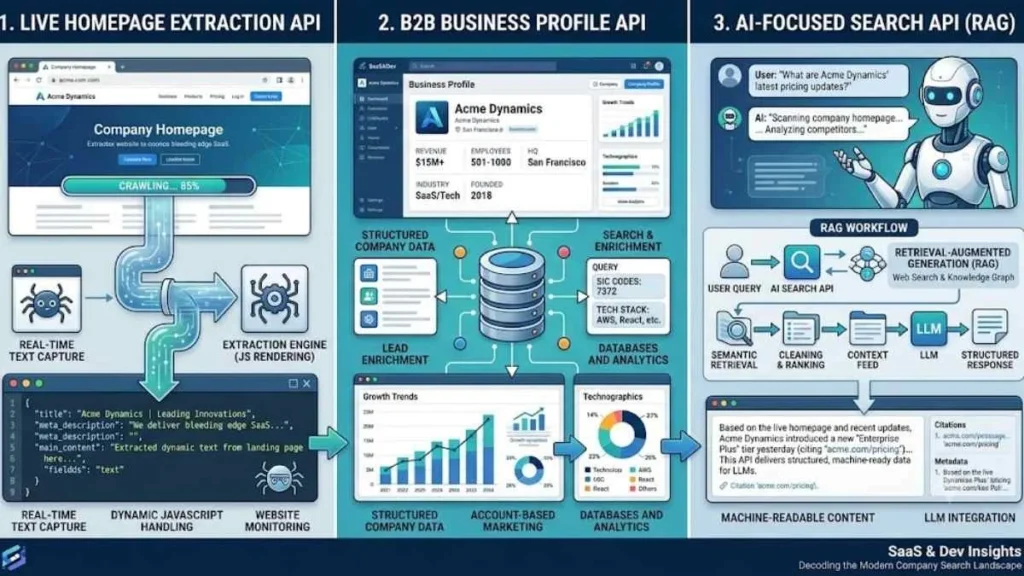
Three Different Types of Company Search APIs
Before evaluating vendors, it helps to separate search APIs into three categories.
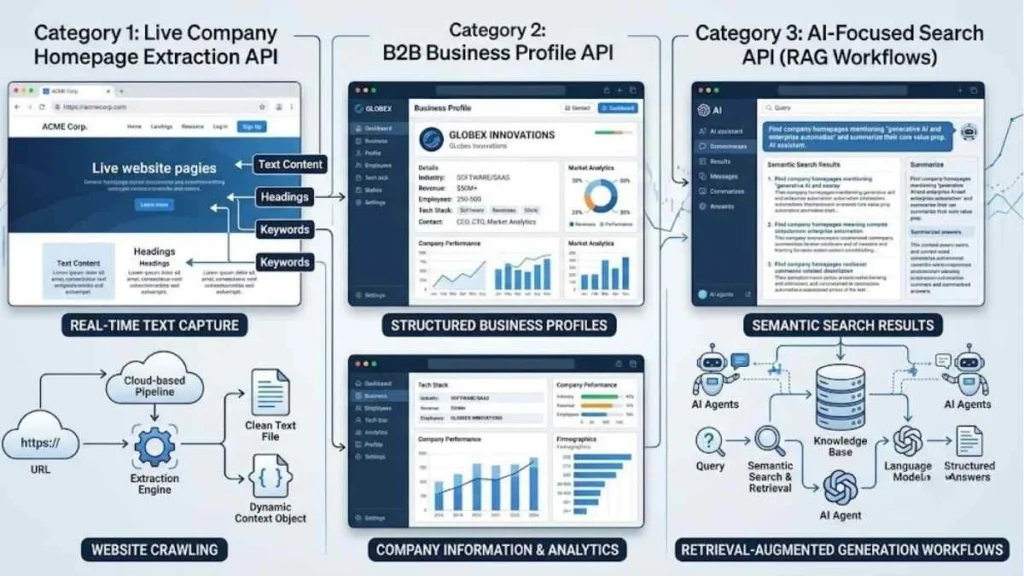
1. Homepage Content Extraction APIs
These APIs focus on retrieving information directly from a company’s website.
Typical use cases include:
- Extracting text from live landing pages
- Monitoring website changes
- Feeding website content into AI models
- Competitive intelligence research
- Automated website summarization
The strength of these APIs is freshness. Because data comes directly from the source website, users can access recently updated information that may not yet appear in databases.
However, homepage extraction APIs often require handling JavaScript rendering, bot protection systems, dynamic content loading, and website structure variations.
2. B2B Company Data APIs
These services maintain large business databases rather than scraping websites in real time.
Common applications include:
- Lead generation
- Account-based marketing
- Company enrichment
- Revenue estimates
- Employee count verification
- Industry classification
These APIs prioritize structured business information over raw webpage content. They typically return standardized company profiles, making them useful for CRM systems and sales workflows.
3. Search APIs for AI Applications
A newer category combines web search, crawling, extraction, and ranking into a single API.
These solutions are increasingly used for:
- Retrieval-augmented generation (RAG)
- AI agents
- Research assistants
- Enterprise knowledge systems
- Real-time question answering
Instead of simply returning URLs, modern AI-focused APIs often provide cleaned content, metadata, summaries, and relevance scoring.
Best API Search Company’s Homepage Options by Use Case
When your primary goal is accessing information directly from company websites, specialized web extraction platforms generally outperform traditional search engines.
A practical example would be monitoring a SaaS company’s pricing page. A dedicated extraction API can capture pricing changes immediately after publication, whereas a traditional search index may take days to update. Sales and marketing teams usually benefit more from company intelligence databases than raw website scraping.
AI-powered applications increasingly need search systems that return machine-friendly data. Consider an AI assistant answering questions about software vendors. Instead of simply retrieving a homepage URL, the API can return relevant text passages, metadata, and source attribution that an LLM can immediately process.
What Actually Matters When Comparing Search APIs
Freshness determines whether results reflect current reality. For company homepage monitoring, freshness is often the most important metric. A stale database may miss product launches, pricing updates, executive changes, or acquisitions.
Developers frequently underestimate the cost of data cleaning. An API returning perfectly structured JSON often saves hundreds of development hours compared with parsing messy HTML. What works for 1,000 searches per month may fail at one million. As AI applications become more common, APIs must provide outputs optimized for language models.
Common Mistakes Buyers Make
Choosing a Sales Database for Web Research
Many teams purchase B2B data providers expecting real-time website intelligence.
The result is often frustration because structured business databases are not designed to monitor homepage changes.
Using Search Engines as Crawlers
Traditional search APIs excel at discovery but may not provide the complete page content needed for analysis.
In many cases, combining search and extraction tools produces better results.
Ignoring Data Quality
A larger database does not automatically mean better data.
Coverage, accuracy, freshness, and consistency often matter more than raw record count.
How to Match the API to Your Goal
The easiest way to choose is by starting with the end objective.
If you need live company website content:
Choose a homepage extraction or crawling API.
If you need company records and business intelligence:
Choose a B2B profile provider.
If you are building AI products or agents:
Choose a search API designed for structured retrieval and machine-readable responses.
If you need all three:
A hybrid architecture often works best, combining search, extraction, and business enrichment services.
Frequently Asked Questions
Can AI agents use search APIs directly?
Yes. Modern AI-focused search APIs are increasingly designed to feed retrieval systems, RAG pipelines, and autonomous agents with structured, machine-readable content.
What is the difference between search APIs and crawling APIs?
Search APIs help discover relevant pages and information sources. Crawling APIs retrieve the actual page content for analysis and processing.
Should startups use multiple APIs?
Often yes. Combining discovery, extraction, and enrichment services can create significantly better results than relying on a single provider.
Conclusion
The Best API Search Company’s Homepage solution depends entirely on what you’re trying to accomplish. Teams focused on monitoring live websites need powerful extraction capabilities. Sales organizations benefit most from structured business-profile databases. AI developers increasingly require APIs that bridge search, retrieval, and machine-readable content.
The most successful implementations start by defining the end goal first and selecting the API architecture second. Rather than searching for a universal “best” provider, focus on finding the platform that aligns with your specific workflow, data freshness requirements, and scalability needs. That approach consistently delivers better results than choosing based on popularity or pricing alone.