

Academic work rarely suffers from a lack of information. The real constraint is access. Lectures stretch for hours, interviews accumulate across projects, and valuable insights remain buried in recordings that few people have time to revisit properly. In this environment, an audio to text converter is less about convenience and more about changing how knowledge is handled, questioned, and reused.
- Academic listening does not scale
- Turning long lectures into navigable study resources
- Research interviews as analyzable material
- Searching for knowledge instead of replaying it
- Summaries as orientation, not substitution
- Writing and citation become smoother
- When efficiency reveals new constraints
- Accessibility and equity in academic contexts
- A different conclusion about transcription
Academic listening does not scale
The limits of linear consumption
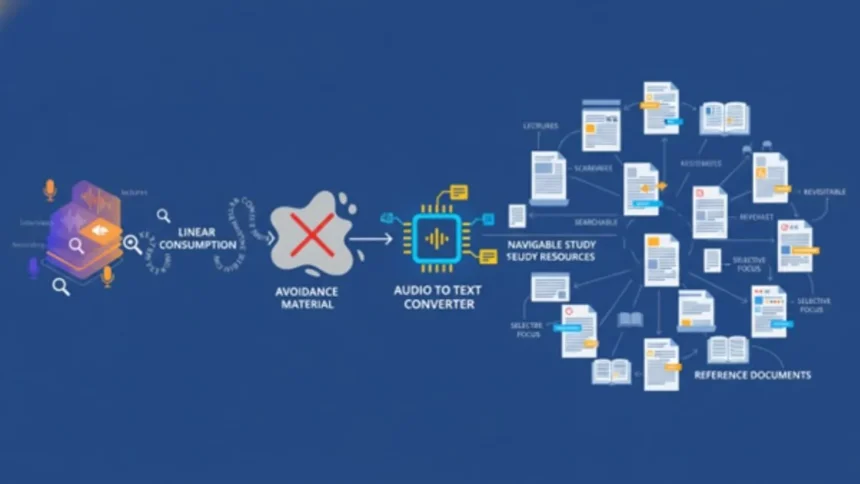
Listening is inherently sequential. You begin at the start and move forward, even when searching for one idea. Academic work, however, depends on comparison, revisiting, and selective focus. Students jump between topics while revising. Researchers move back and forth between evidence and interpretation.
Audio resists this behavior. Each replay demands time and attention, often for only a few relevant sentences. Over weeks and months, this inefficiency compounds and quietly shapes what material actually gets used.
When recordings become avoidance material
Many students record lectures with good intentions and rarely listen again. Researchers archive interviews and postpone transcription indefinitely. The medium itself discourages engagement.
This is usually the moment when an audio to text converter becomes attractive. Not as a productivity trick, but as a way to lower the psychological cost of returning to material that matters.
Turning long lectures into navigable study resources
From recorded sessions to reference documents
Once lectures are converted into text, their role changes. They stop being passive recordings and become reference materials. Definitions can be searched. Arguments can be revisited without replaying entire sessions.
Using an audio to text converter in this context allows students to study lectures the way they study textbooks, selectively and repeatedly. This aligns better with how learning actually happens.
Precision enables trust
Academic use demands accuracy, but not only at the word level. Knowing where something was said matters. Precise timestamps allow students to verify context and researchers to trace claims back to their source.
When timestamps are accurate to the second, citations become defensible. Notes become reliable. The transcript stops feeling like an approximation and starts functioning as a legitimate academic artifact.
Research interviews as analyzable material
Transcripts change analytical depth
In qualitative research, analysis rarely happens during listening. It happens during rereading, coding, and comparison. Audio alone limits this process.
An audio to text converter transforms interviews into material that can be highlighted, categorized, and cross-referenced. Researchers move faster not because they rush, but because they spend more time analyzing and less time searching.
This shift often leads to deeper engagement with data rather than superficial summaries.
Speaker clarity preserves methodological rigor
Interviews frequently involve multiple participants. Without speaker differentiation, transcripts blur perspectives. Attribution becomes uncertain.
Clear speaker identification keeps the meaning intact. It supports accurate quoting and ethical representation of participants’ voices, which is essential in serious research contexts.
Searching for knowledge instead of replaying it
Keyword retrieval as a thinking tool
Once lectures and interviews exist as text, keyword search becomes central. Students search for terms they don’t yet fully understand. Researchers search for recurring concepts across interviews.
This behavior changes how questions are formed. Instead of passively absorbing content, users actively interrogate it. Text enables this shift in a way audio cannot.
An audio to text converter supports inquiry by making language accessible rather than locked behind playback controls.
Building cumulative understanding
Over time, transcripts accumulate. Courses, seminars, interviews, conferences. Together, they form a personal archive of spoken knowledge.
This archive allows patterns to emerge. Ideas can be traced across sessions. Arguments can be compared longitudinally. Academic understanding deepens through connection, not repetition.
Summaries as orientation, not substitution
Reducing the entry cost of complex material
Long transcripts can feel overwhelming. Summaries help users orient themselves before engaging deeply.
When summaries are grounded in transcripts, they act as guides rather than replacements. Students preview lectures before revision. Researchers recall interview focus before analysis.
This reduces cognitive friction while preserving depth.
Supporting supervision and peer review
In academic collaboration, not everyone can review full recordings. Summaries provide shared context without forcing uniform consumption.
They enable informed discussion and feedback while keeping original material available for verification.
Writing and citation become smoother
Moving from spoken evidence to written argument
Academic writing depends on precise language and sourcing. When evidence remains in audio form, writing slows.
Text-based transcripts allow direct quotation, paraphrasing, and citation. Writers move fluidly between evidence and interpretation. The distance between hearing an idea and writing about it narrows.
An audio to text converter effectively shortens the path from data to argument.
Exporting text across academic workflows
Different tasks require different formats. Notes, drafts, appendices, and analysis documents all use text differently.
Exportable transcripts allow material to move seamlessly between tools without reformatting. This continuity reduces friction across the research lifecycle.
When efficiency reveals new constraints
Video and storage as secondary bottlenecks
As transcription becomes efficient, other issues surface. Sharing long lecture videos or interview recordings can slow collaboration.
In these cases, pairing text-based workflows with a simple video compressor helps maintain accessibility without sacrificing source material. Each tool addresses a distinct problem without overlap.
Keeping workflows cognitively light
Academic users abandon tools that demand configuration or constant adjustment. Reliability matters more than customization.
Audio-based material converted through a consistent audio to text converter fits more naturally into existing habits. Upload, convert, read. The simplicity encourages continued use over time.
Accessibility and equity in academic contexts
Lowering barriers to engagement
Text supports diverse learning needs. Students with hearing impairments, non-native speakers, and those studying in noisy environments all benefit from transcripts.
Accessibility is not an add-on. It directly influences who can engage with material fully and independently.
Free access and sustained use
Cost affects behavior. Free tools encourage consistent use rather than occasional experimentation. Students are more likely to transcribe older lectures. Researchers revisit archived interviews.
This sustained engagement increases the long-term value of recorded material.
A different conclusion about transcription
Transcription is often framed as a time-saving measure. In academic contexts, its deeper impact lies elsewhere. It reshapes how material is revisited, questioned, and integrated into thinking.
An audio to text converter that supports precise timestamps, a reliable structure, and flexible export does more than convert speech. It aligns recorded knowledge with the non-linear nature of academic work. For students and scholars, this alignment changes not just how fast they work, but how deeply they engage with what they already have.